Independent merger-arbitrage case study · Public information only
Brighthouse / Aquarian: a $22 spread priced for failure
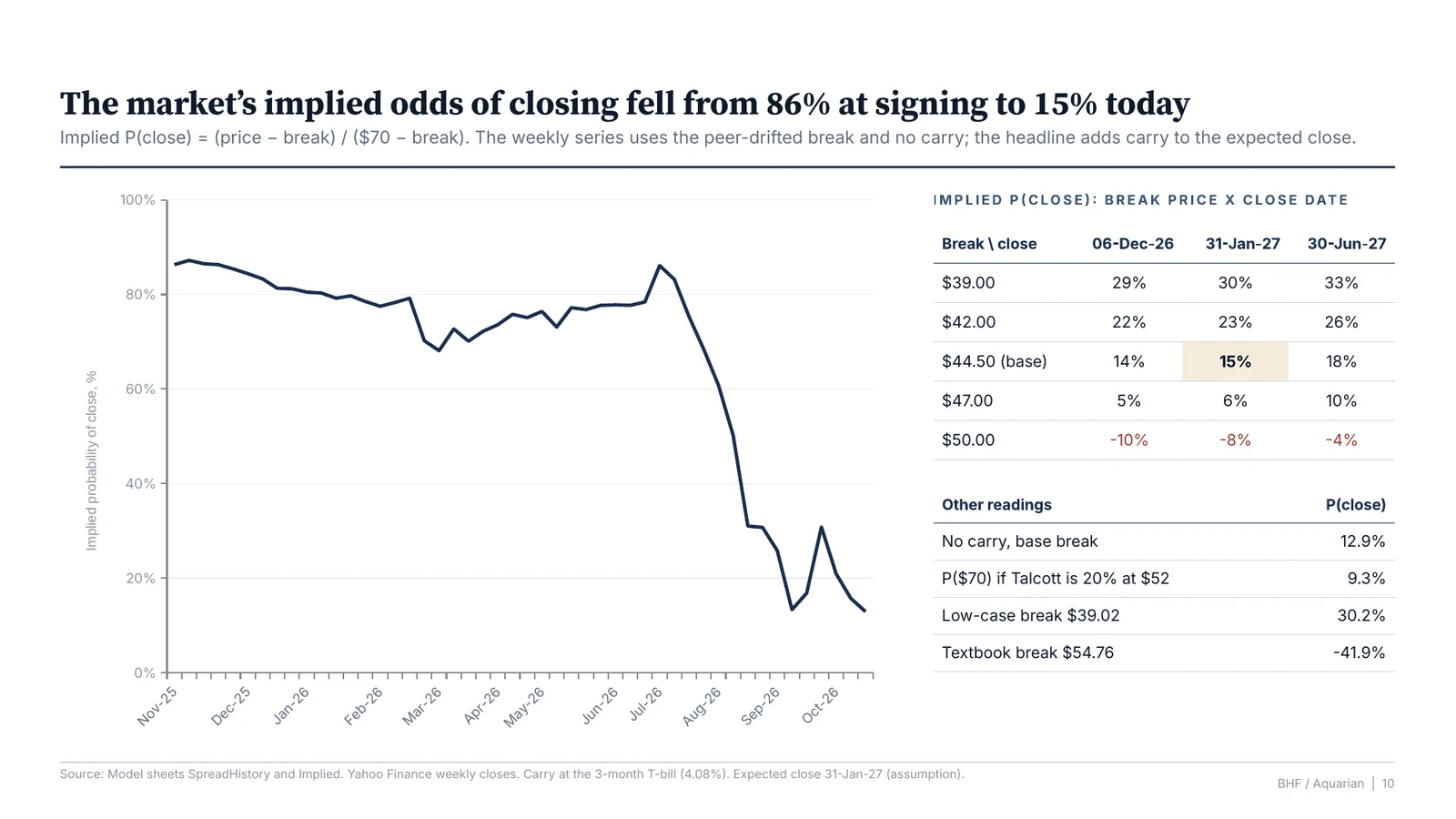
Aquarian's $70.00 cash deal has cleared the vote, HSR and FINRA, but Delaware has posted no hearing notice 296 days after the Form A filings. At $47.80 the $22.20 spread (46.4%) implies only a 15.2% chance of closing. We put it at 25%, so the trade is a small, hedged option on approval — not a classic low-risk arb.
Recommendation
Long BHF: 2% NAV starter, 3% max
Hedged 0.43x CRBG/JXN/LNC short
Expected PV
$51.00
+6.7% vs $47.80 · base break $44.50
P(close): mkt vs. ours
15.2% vs 25%
Market-implied vs. our estimate
Spread
$22.20
46.4% to the $70.00 cash offer
Not prepared for, reviewed by, or affiliated with Brighthouse Financial, Aquarian Capital, Talcott Financial Group, or any employer or client. Not investment advice. All figures in US$.
Recommendation
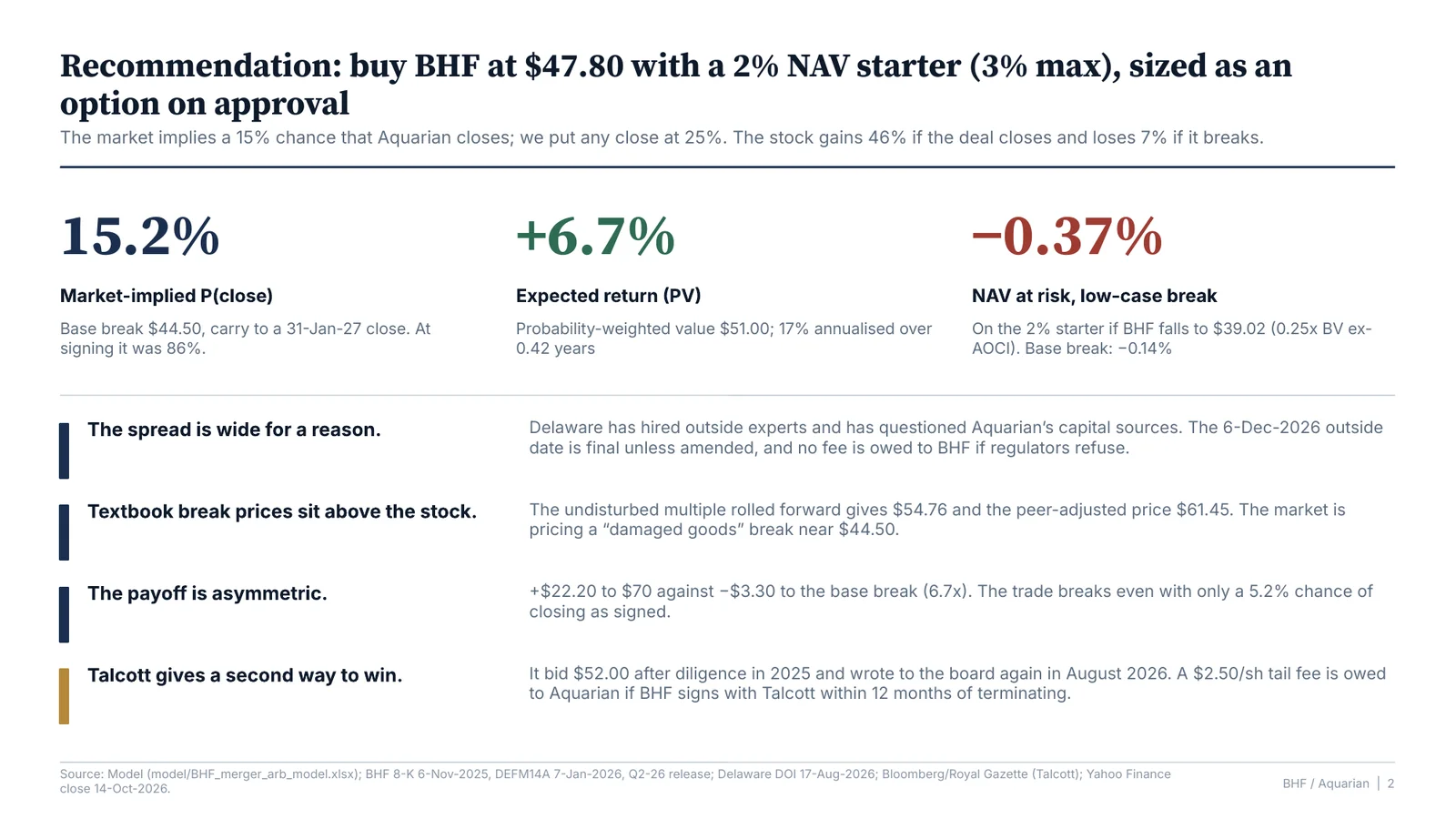
Buy BHF at $47.80 with a 2% NAV starter, capped at 3%. Size it as an option on regulatory approval, not as a classic low-risk arbitrage.
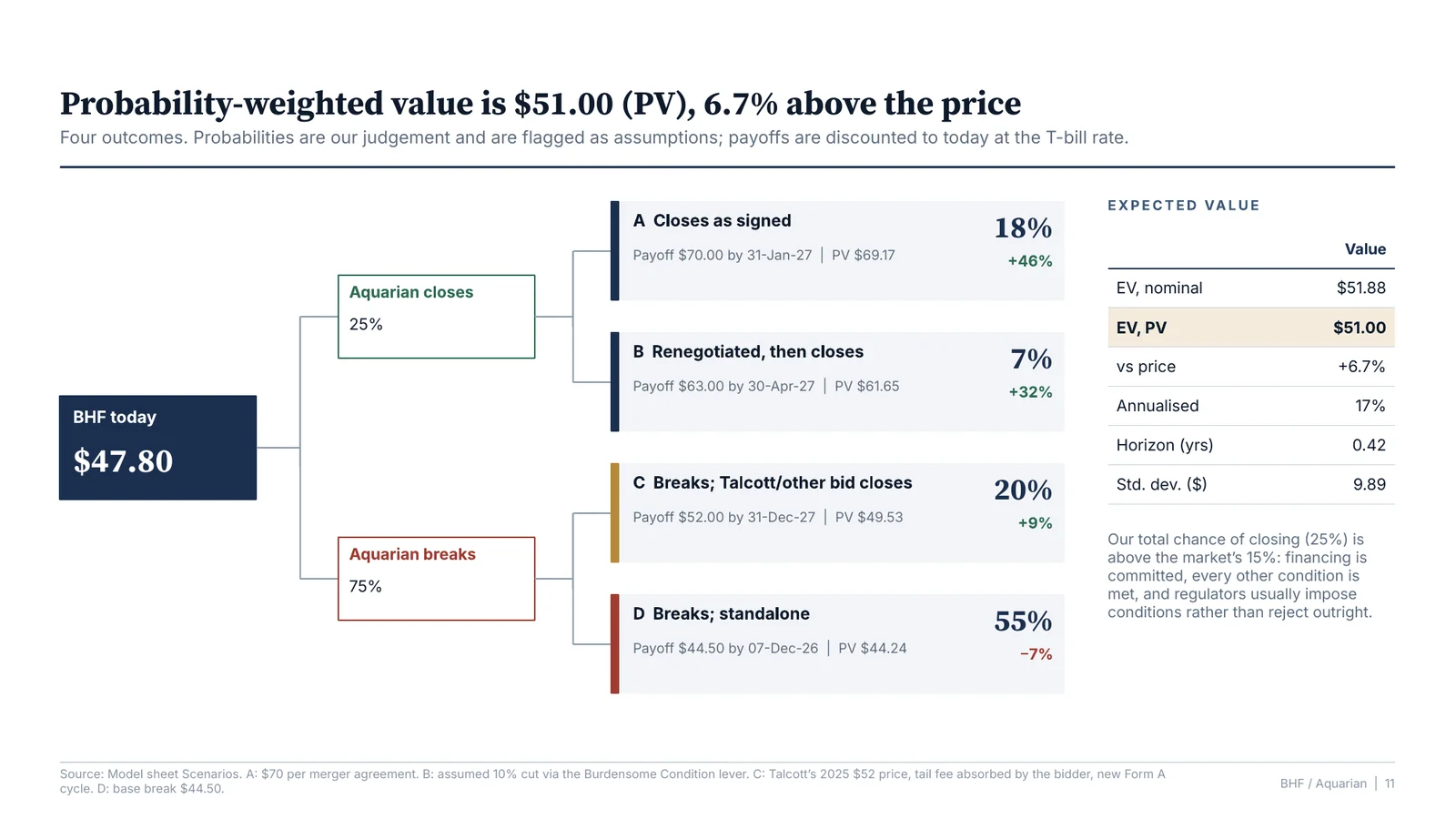
- The market implies a 15.2% chance that Aquarian closes. That uses a $44.50 break price and carry to a 31-Jan-2027 close. At signing the same measure was 86%. We put the chance of any close at 25%: 18% as signed and 7% after a renegotiation.
- The expected return is +6.7% on a PV basis (probability-weighted value $51.00), or 17% annualised over a 0.42-year average horizon.
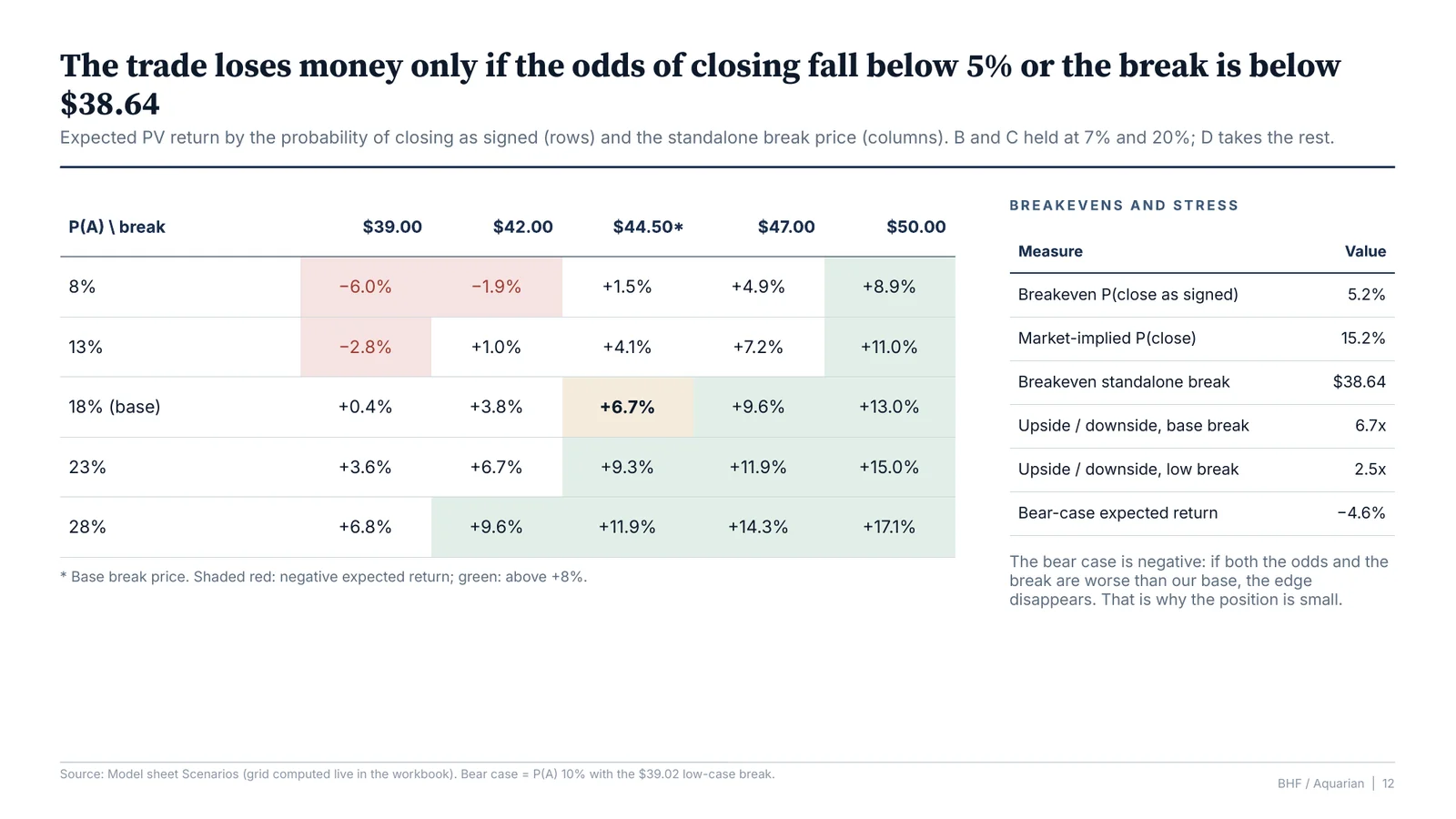
- The payoff is asymmetric. The upside to $70 is $22.20; the downside to the base break is $3.30, a ratio of 6.7x. The trade breaks even with only a 5.2% chance of closing as signed.
- The risk is small in NAV terms. A 2% starter loses 0.14% of NAV in the base break and 0.37% in the low case ($39.02).
- Talcott offers a second way to win. It bid $52.00 after diligence in 2025 and, according to Bloomberg, wrote to the board again in August 2026.
1. The deal and where it stands
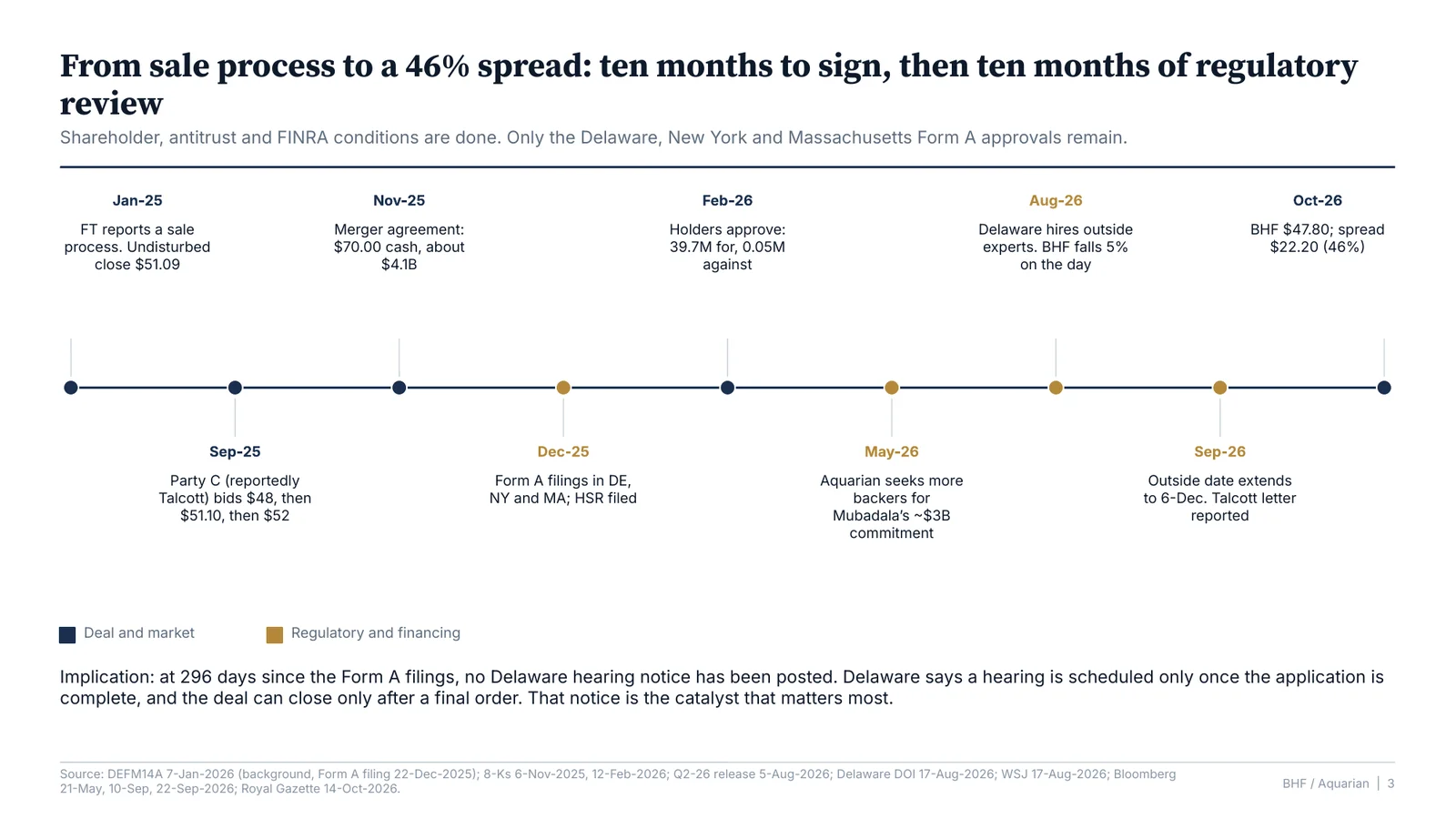
Aquarian Holdings VI L.P. agreed on 6-Nov-2025 to buy Brighthouse for $70.00 a share in cash, about $4.1B. That was a 37.0% premium to the $51.09 undisturbed close on 27-Jan-2025, the last close before the FT reported a sale process.
| Date | Event |
|---|---|
| Jan-2025 | FT reports a sale process. Undisturbed close $51.09 |
| Sep-2025 | Party C (reported to be Talcott) bids $48, then $51.10, then $52.00 with exclusivity. Exclusivity lapses |
| 6-Nov-2025 | Merger agreement signed at $70.00 |
| 19/22-Dec-2025 | HSR filed; Form A filed in Delaware, New York and Massachusetts |
| 12-Feb-2026 | Holders approve: 39.7M shares for, 0.05M against (69.5% of shares outstanding) |
| May-2026 | Bloomberg: Aquarian seeks more backers for Mubadala’s ~$3B commitment |
| 17-Aug-2026 | Delaware says it has hired outside experts. BHF falls 5% (WSJ) |
| 6-Sep-2026 | Outside date extends automatically to 6-Dec-2026. Bloomberg reports a Talcott letter (22-Sep) |
| 14-Oct-2026 | BHF $47.80; spread $22.20 (46.4%) |
The stockholder vote, HSR and FINRA are done; the Q2-26 release says “all other conditions” are satisfied or waived. Only the three Form A approvals remain. It has been 296 days since the Form A filings, and no Delaware hearing notice has been posted. Delaware says a hearing is scheduled only once the application is complete, and the deal can close only after a final order.
2. The contract protects Aquarian, not BHF, if the regulators say no
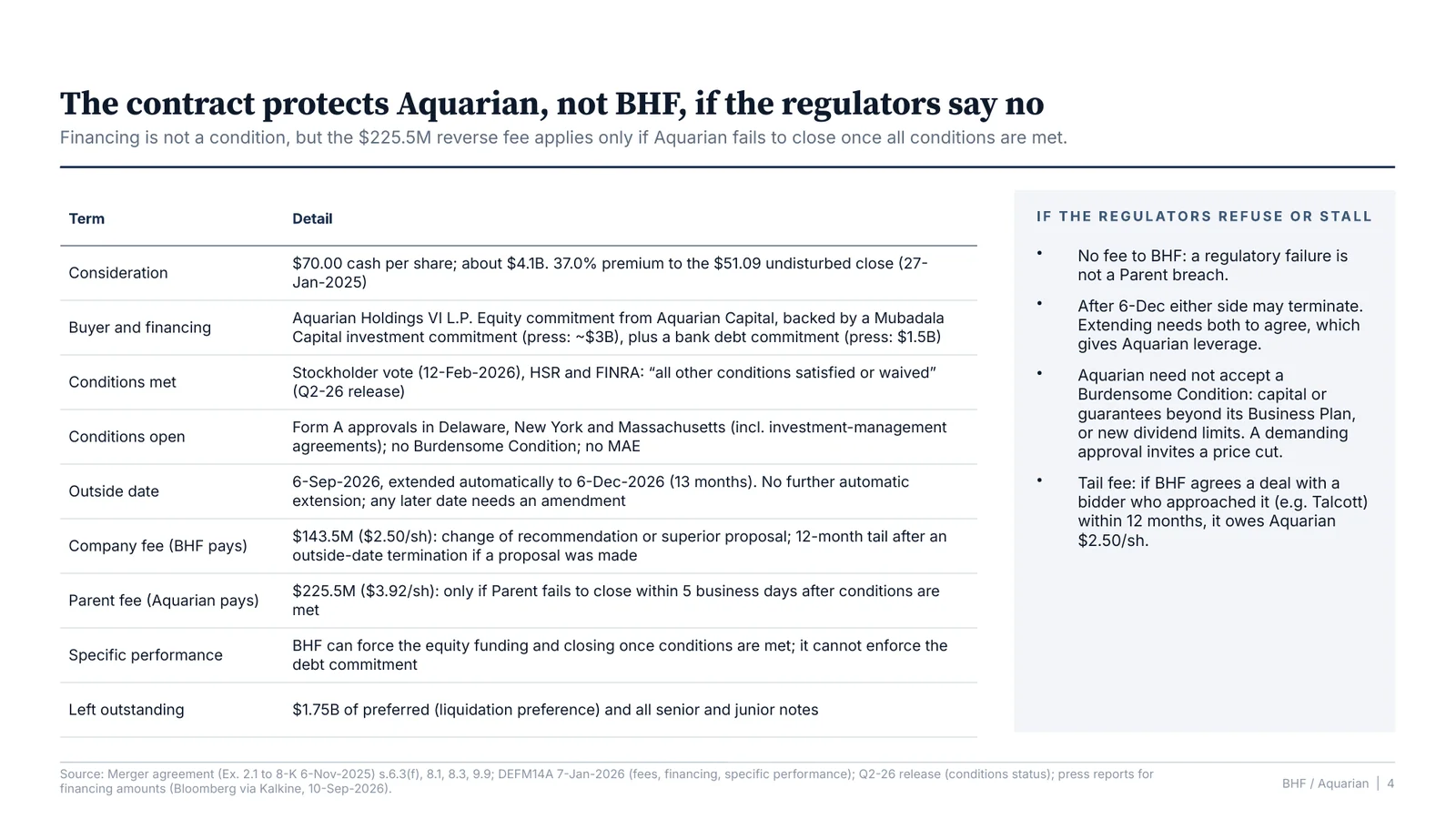
| Term | Detail |
|---|---|
| Consideration | $70.00 cash per share; about $4.1B |
| Buyer and financing | Equity commitment from Aquarian, backed by a Mubadala investment commitment (press: ~$3B) and a bank debt commitment (press: $1.5B). Financing is not a condition |
| Conditions open | Form A approvals in DE, NY and MA (including investment-management agreements); no Burdensome Condition; no MAE |
| Outside date | 6-Sep-2026, extended automatically to 6-Dec-2026 (13 months). No further automatic extension |
| Company fee (BHF pays) | $143.5M ($2.50/sh), with a 12-month tail after an outside-date termination if an acquisition proposal was made |
| Parent fee (Aquarian pays) | $225.5M ($3.92/sh), only if Aquarian fails to close within 5 business days after all conditions are met |
| Specific performance | BHF can force the equity funding and closing once conditions are met. It cannot enforce the debt commitment |
| Left outstanding | $1.75B of preferred (liquidation preference) and all senior and junior notes |
A regulatory failure is not a breach by Aquarian, so BHF receives nothing if the regulators refuse. After 6-Dec either side can terminate, and an extension needs both to agree, which gives Aquarian leverage. Aquarian also does not have to accept a “Burdensome Condition” (s.6.3(f)): a capital contribution, guarantee or minimum capital beyond its Business Plan, or new dividend limits. A demanding approval therefore invites a price cut.
3. The spread and the return if it closes
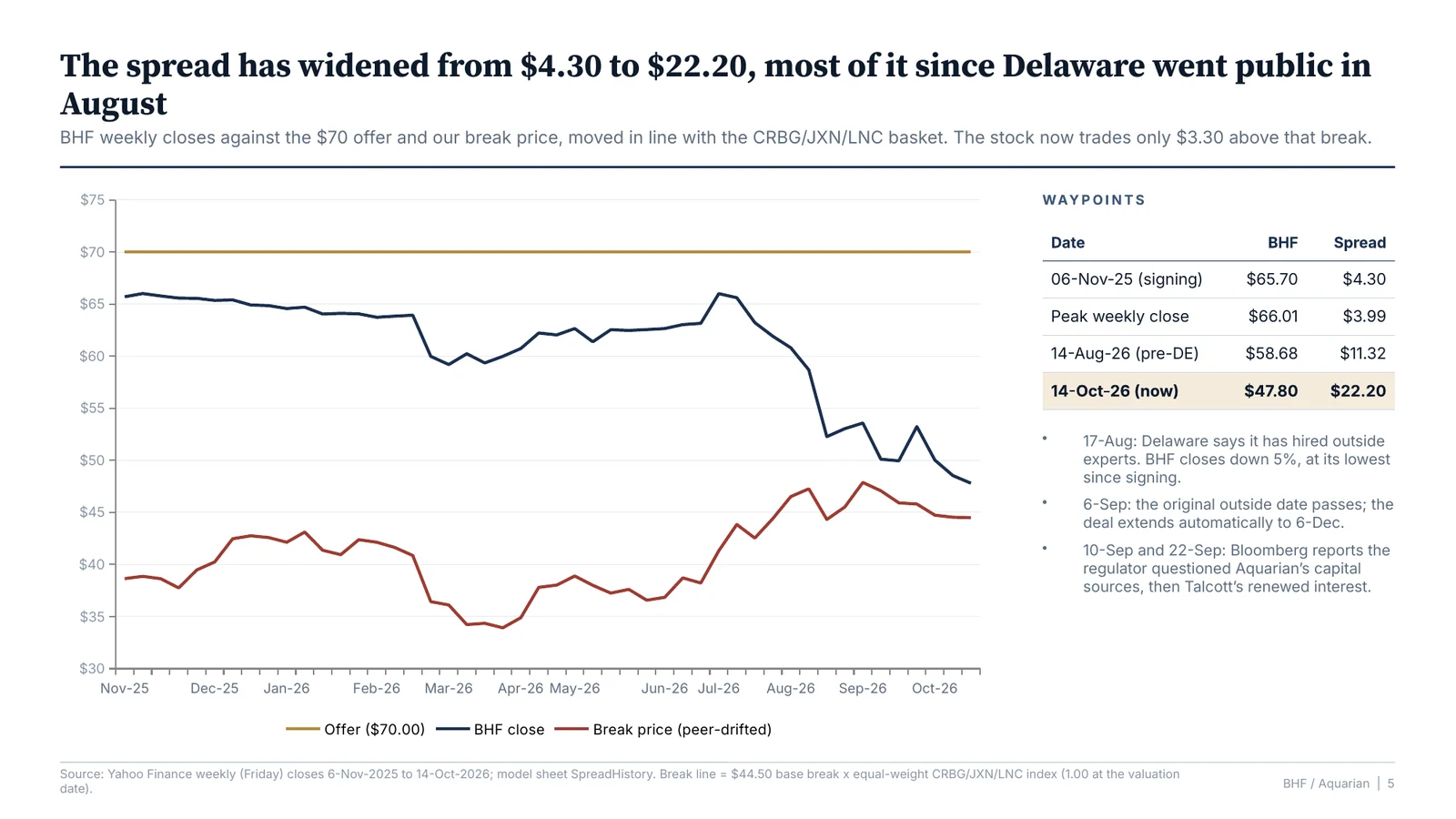
The spread was $4.30 at signing. It is now $22.20 (46.4%), most of the widening since Delaware went public in August. Before that statement (14-Aug-2026) BHF closed at $58.68, which implied a 50% chance of closing. The peak weekly close was $66.01.
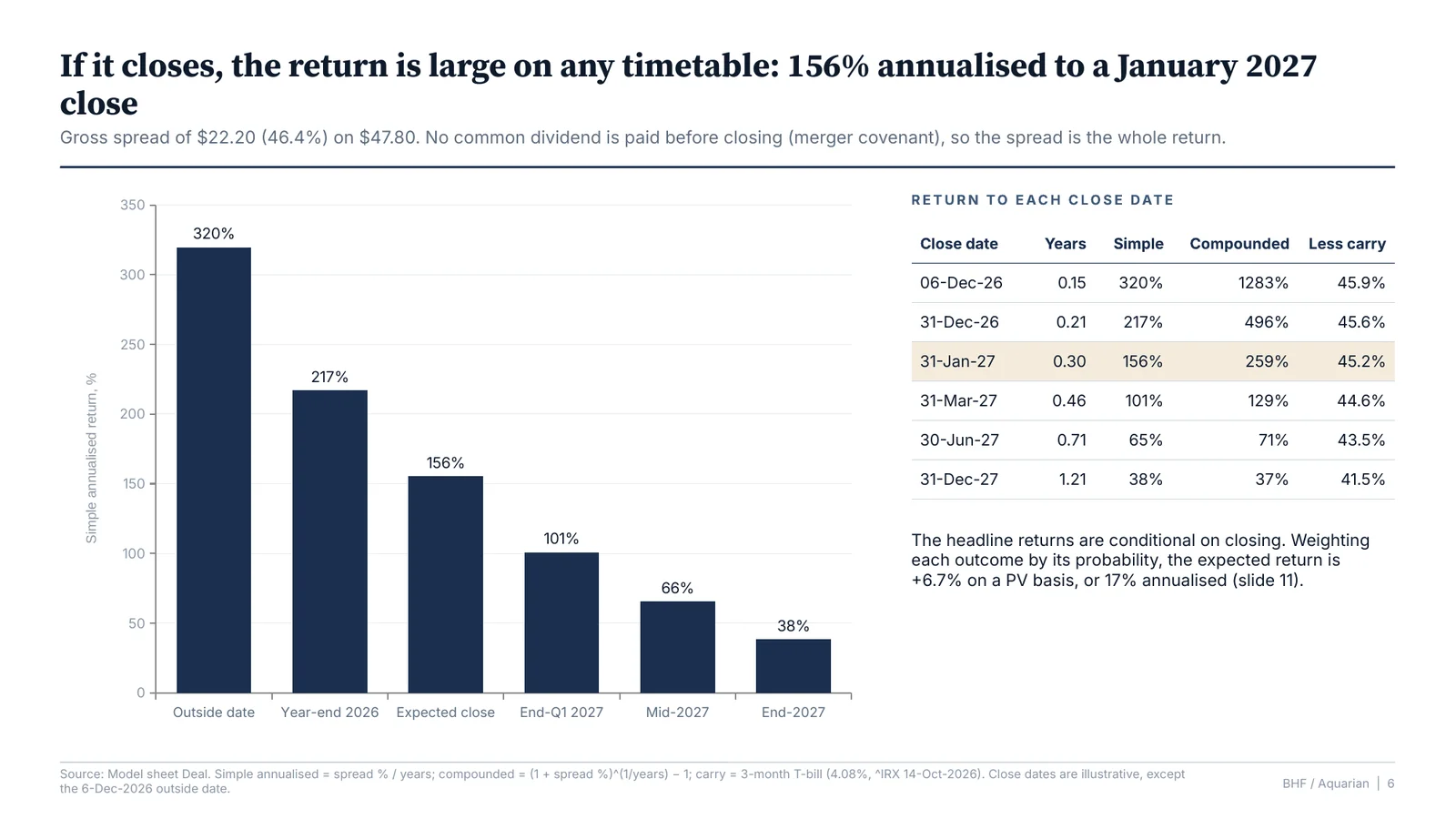
BHF pays no common dividend before closing (merger covenant), so the spread is the whole return.
| Close date | Years | Simple annualised | Compounded | Return less carry |
|---|---|---|---|---|
| 06-Dec-26 (outside date) | 0.15 | 320% | 1,283% | 45.9% |
| 31-Dec-26 | 0.21 | 217% | 496% | 45.6% |
| 31-Jan-27 (base) | 0.30 | 156% | 259% | 45.2% |
| 31-Mar-27 | 0.46 | 101% | 129% | 44.6% |
| 30-Jun-27 | 0.71 | 65% | 71% | 43.5% |
| 31-Dec-27 | 1.21 | 38% | 37% | 41.5% |
Carry is the 3-month T-bill (4.08%, ^IRX on 14-Oct-2026). These returns are conditional on closing; section 6 weights them by probability.
4. Standalone value: statutory capital explains the discount
| Metric | At $47.80 | At $70.00 |
|---|---|---|
| Price / book value ($84.35) | 0.57x | 0.83x |
| Price / BV ex-AOCI ($156.10) | 0.31x | 0.45x |
| Equity value / statutory TAC ($4.9B) | 0.56x | 0.82x |
| P / LTM adjusted EPS less notables ($17.27) | 2.8x | 4.1x |
| Equity value ($M) | 2,749 | 4,026 |
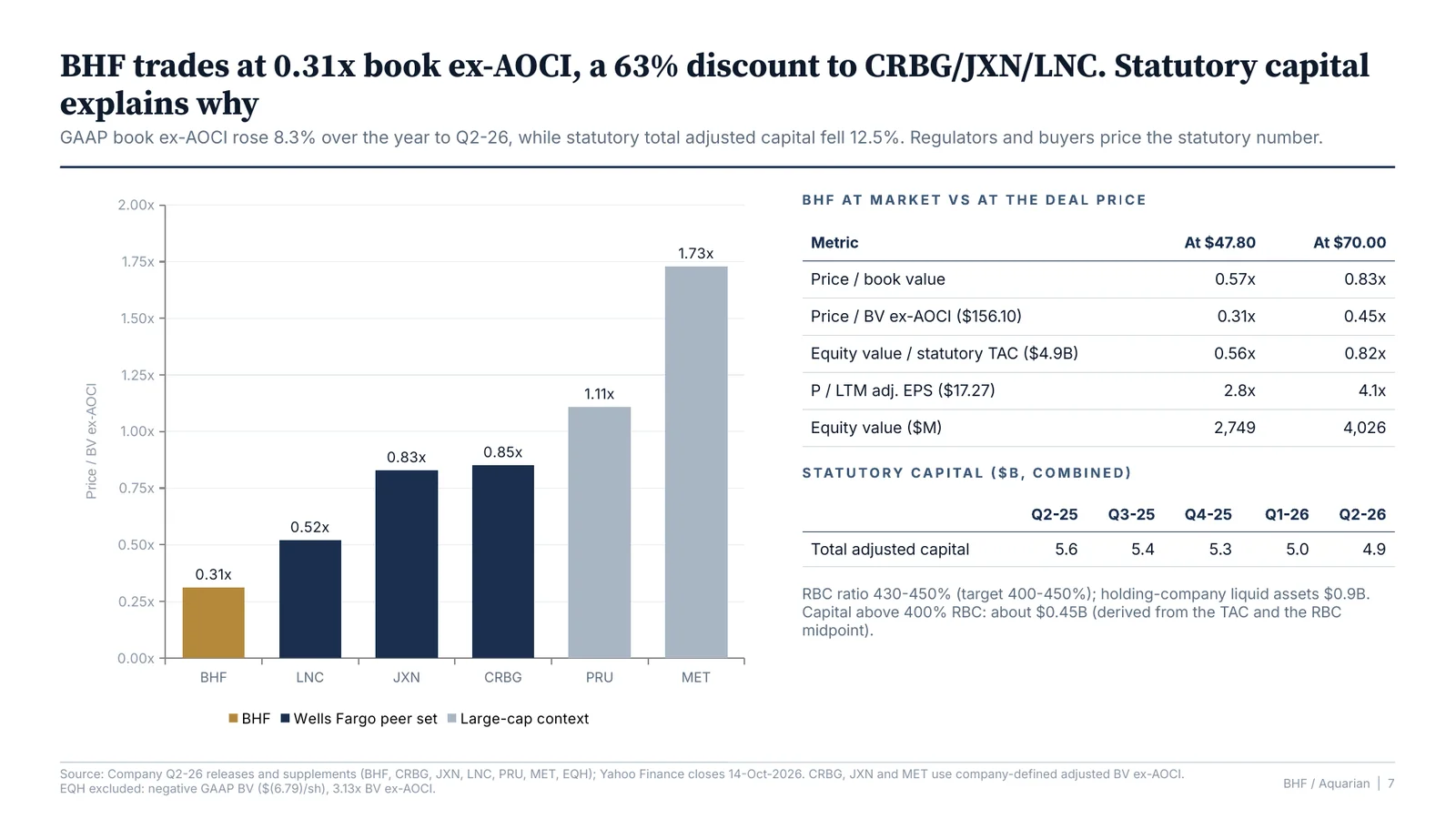
BHF trades at 0.31x book ex-AOCI, a 63% discount to the median of the Wells Fargo peer set (CRBG 0.85x, JXN 0.83x, LNC 0.52x; median 0.83x). PRU (1.11x) and MET (1.73x) are shown for context. EQH is excluded because its GAAP book value is negative.
The reason is statutory capital. GAAP book ex-AOCI rose 8.3% in the year to Q2-26, but combined total adjusted capital fell 12.5%, from $5.6B to $4.9B. The RBC ratio is 430-450% against a 400-450% target, and the holding company holds $0.9B of liquid assets. Capital above 400% RBC is only about $0.45B (derived from TAC and the RBC midpoint). Regulators and buyers price the statutory number.
5. The break price: textbook methods sit above the stock
| Method | Basis | $/sh | Weight |
|---|---|---|---|
| M1 Bidder-implied | Talcott’s $52.00 diligenced 2025 bid / (1 + 20.9% median premium) | $43.01 | 1/3 |
| M2 Fairness-opinion DDM | Midpoints of the Goldman and Wells Fargo DDM ranges (30-Jun-2025) | $43.66 | 1/3 |
| M3 Trough multiple | 0.30x Q2-26 BV ex-AOCI (low end of the WF precedent range) | $46.83 | 1/3 |
| Base break price | $44.50 | ||
| Low case | 0.25x BV ex-AOCI (low end of the Goldman range) | $39.02 | stress |
| R1 Textbook roll-forward | Undisturbed 0.351x (51.09 / 145.63) x $156.10 | $54.76 | high case |
| R2 Textbook peer-adjusted | $51.09 x CRBG/JXN/LNC basket return since 27-Jan-25 (+20.3%) | $61.45 | reference |
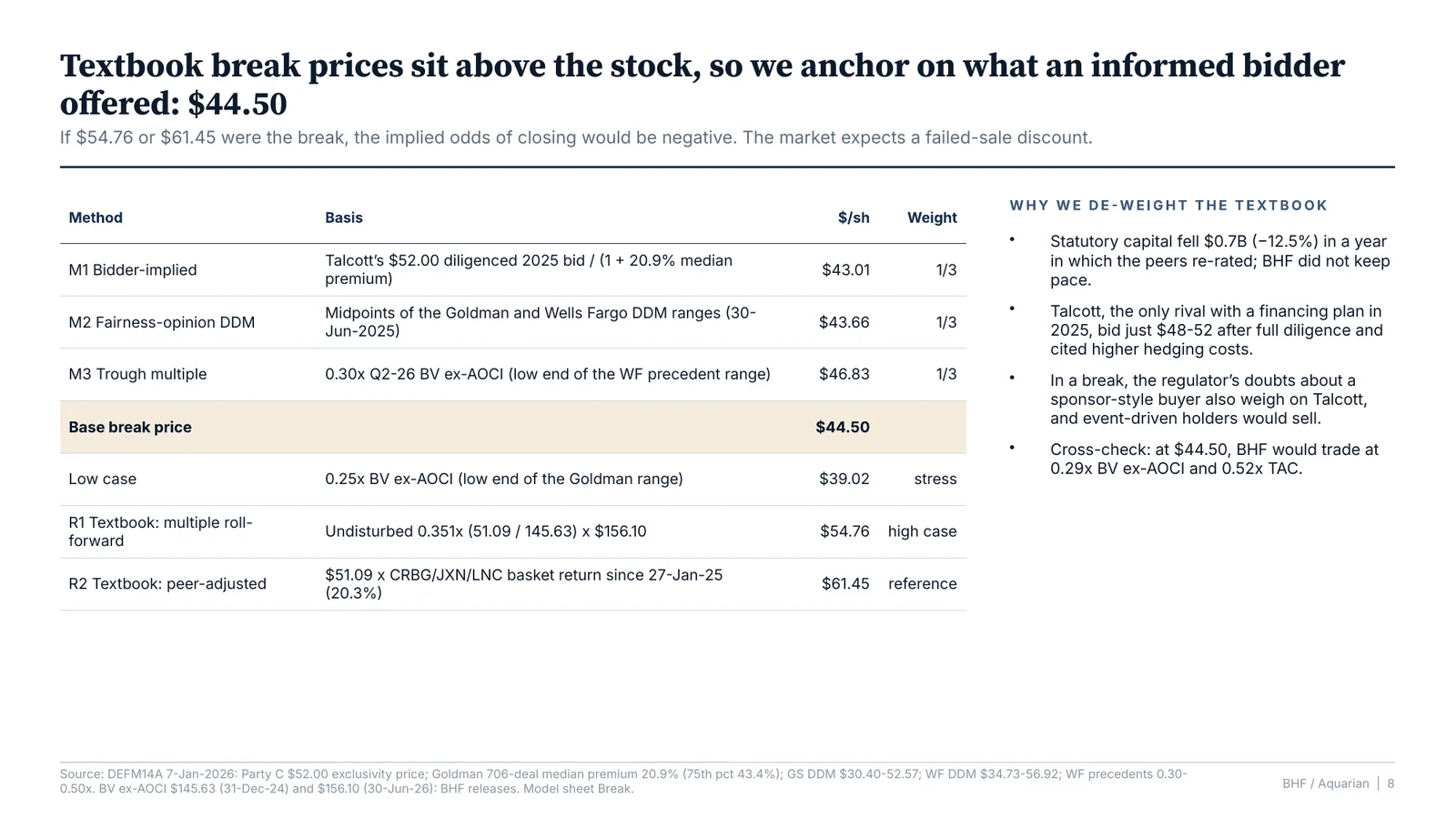
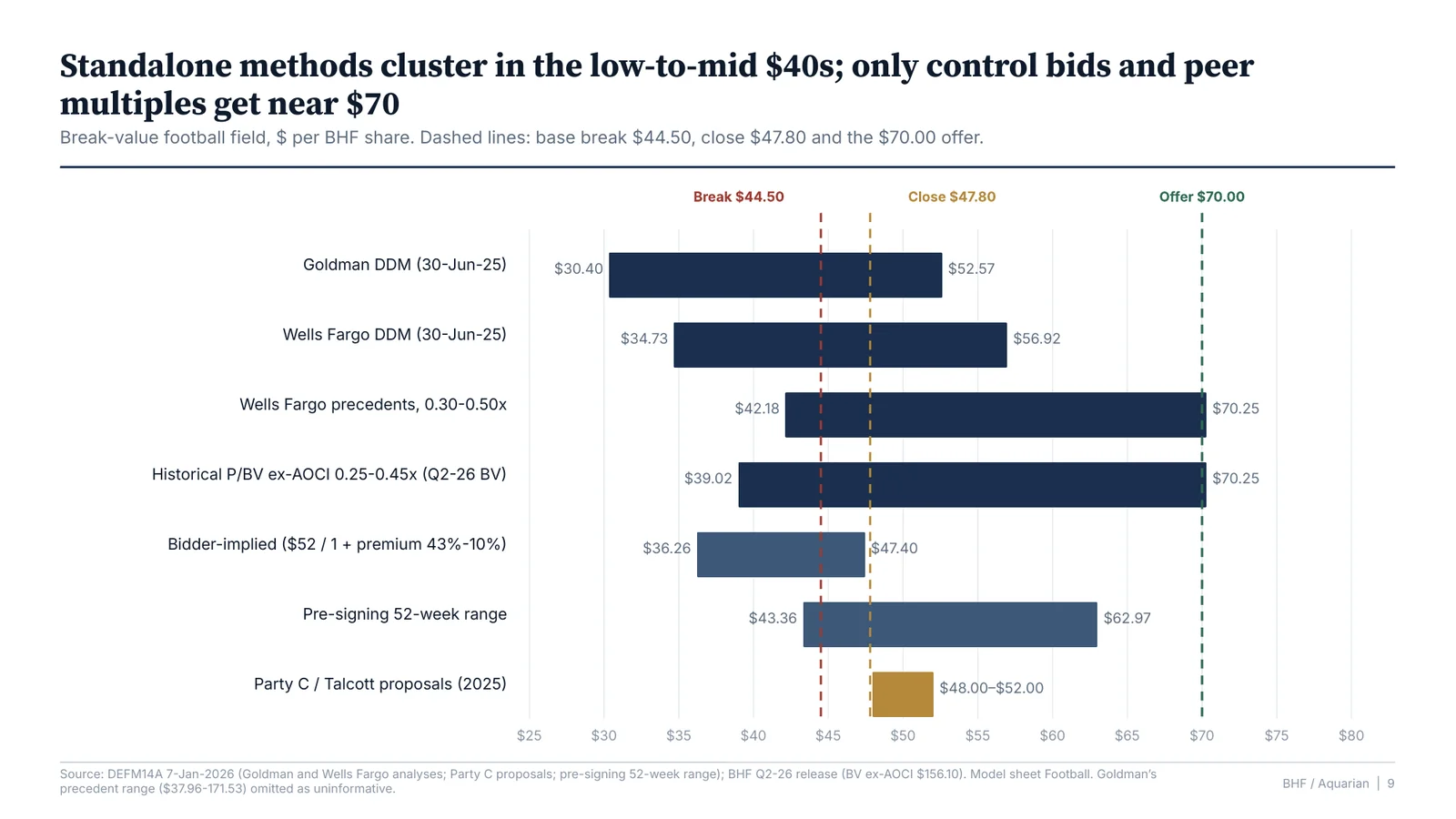
If the break were $54.76 or $61.45, the implied chance of closing would be negative (-42% and -153%). The market is pricing a “damaged goods” break, and we think it is right to:
- Statutory capital fell $0.7B in a year in which peers re-rated.
- Talcott, the only rival with a financing plan in 2025, bid just $48-52 after full diligence and cited higher hedging costs.
- In a break, the regulator’s doubts about a sponsor-style buyer would also weigh on Talcott, and event-driven holders would sell.
- At $44.50 BHF would trade at 0.29x BV ex-AOCI and 0.52x TAC.
The football field confirms the picture. The Goldman DDM ($30.40-52.57), Wells Fargo DDM ($34.73-56.92) and bidder-implied range ($36.26-47.40) cluster in the low-to-mid $40s. Only the precedent multiples (WF $42.18-70.25; 0.25-0.45x BV ex-AOCI $39.02-70.25), the pre-signing 52-week range ($43.36-62.97) and Talcott’s proposals ($48-52) reach higher.
6. What the market implies, and what we think
Implied P(close) = (price - break) / ($70 - break), with carry to the expected close.
| Break \ close | 06-Dec-26 | 31-Jan-27 | 30-Jun-27 |
|---|---|---|---|
| $39.00 | 29% | 30% | 33% |
| $42.00 | 22% | 23% | 26% |
| $44.50 (base) | 14% | 15% | 18% |
| $47.00 | 5% | 6% | 10% |
| $50.00 | -10% | -8% | -4% |
Other readings: 12.9% with no carry; 9.3% for a $70 close if Talcott is given 20% at $52; 30.2% with the low-case break.
Scenario tree (probabilities are our judgement and are flagged as assumptions):
| Scenario | Probability | Payoff | Date | PV | Return |
|---|---|---|---|---|---|
| A. Closes as signed | 18% | $70.00 | 31-Jan-27 | $69.17 | +46% |
| B. Renegotiated, then closes | 7% | $63.00 | 30-Apr-27 | $61.65 | +32% |
| C. Breaks; Talcott or another bid closes | 20% | $52.00 | 31-Dec-27 | $49.53 | +9% |
| D. Breaks; standalone | 55% | $44.50 | 07-Dec-26 | $44.24 | -7% |
Expected value is $51.88 nominal and $51.00 PV, +6.7% above the price (17% annualised; standard deviation $9.89). Our 25% chance of any close is above the market’s 15% because financing is committed, every other condition is met, and regulators usually impose conditions rather than reject outright. Scenario B assumes a 10% cut via the Burdensome Condition lever. Scenario C uses Talcott’s 2025 price, assumes the bidder absorbs the $2.50 tail fee, and allows for a new Form A cycle.
Sensitivity. The expected PV return stays positive unless the chance of closing as signed falls below 5.2% or the standalone break falls below $38.64 (each with the other inputs at base). The bear case (18% replaced by 10%, low-case break) returns -4.6%. That is why the position is small.
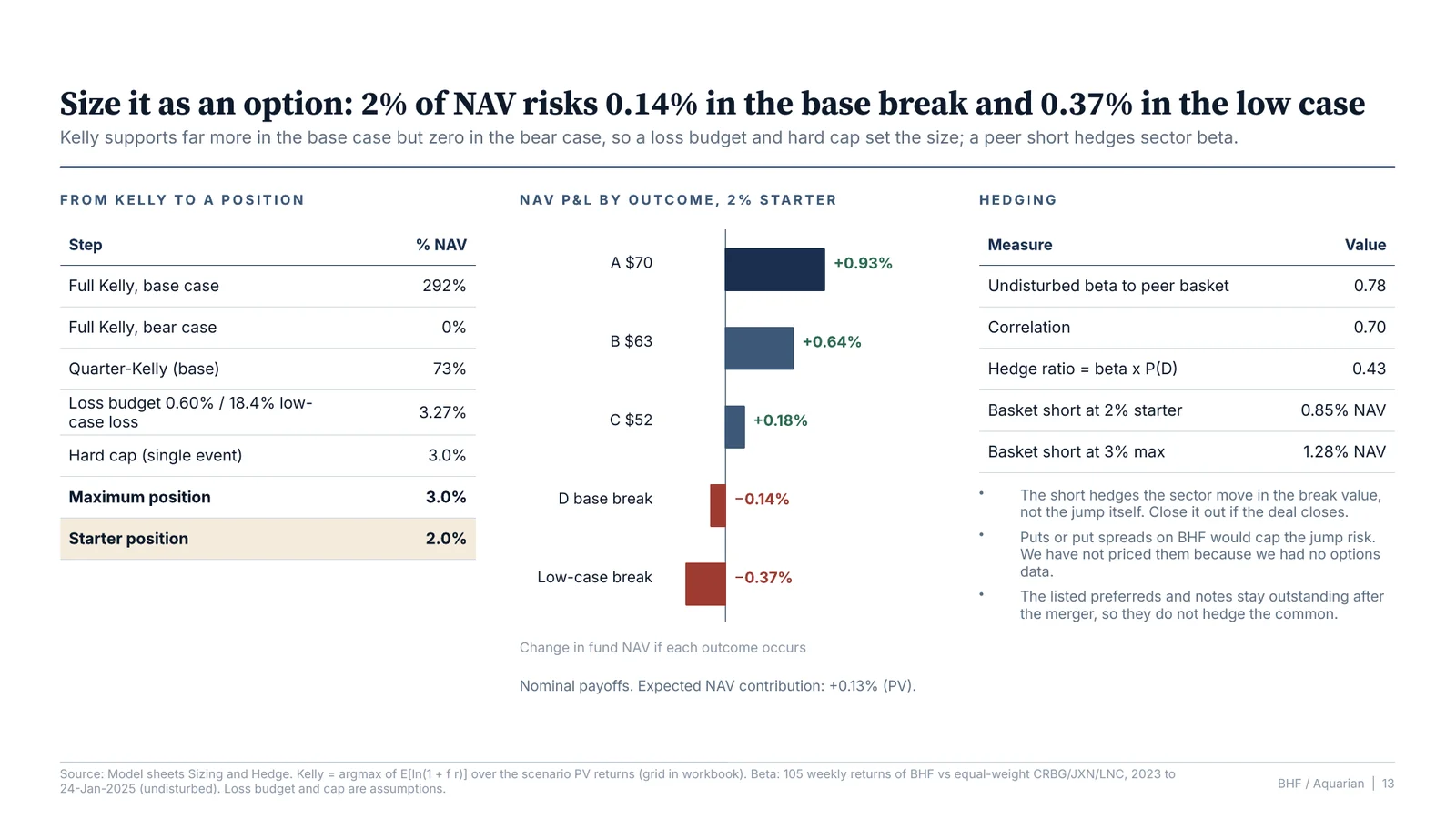
7. Sizing and hedging
| Step | % NAV |
|---|---|
| Full Kelly, base case | 292% |
| Full Kelly, bear case | 0% |
| Quarter-Kelly (base) | 73% |
| Loss budget 0.60% / 18.4% low-case loss | 3.27% |
| Hard cap (single event) | 3.0% |
| Maximum position | 3.0% |
| Starter position | 2.0% |
Kelly supports far more in the base case but zero in the bear case, so a loss budget and a hard cap set the size. At 2% of NAV the outcomes are: A +0.93%, B +0.64%, C +0.18%, D -0.14%, low case -0.37%. The expected NAV contribution is +0.13% (PV).
Hedge. BHF’s undisturbed beta to an equal-weight CRBG/JXN/LNC basket was 0.78 (correlation 0.70; 105 weekly returns, 2023 to 24-Jan-2025). The hedge ratio is beta x P(D) = 0.43, or a basket short of 0.85% of NAV at the starter (1.28% at the max). The short hedges the sector move in the break value, not the jump itself; close it if the deal closes. BHF puts would cap the jump risk, but we have not priced them because we had no options data. The listed preferreds and notes stay outstanding after the merger, so they do not hedge the common.
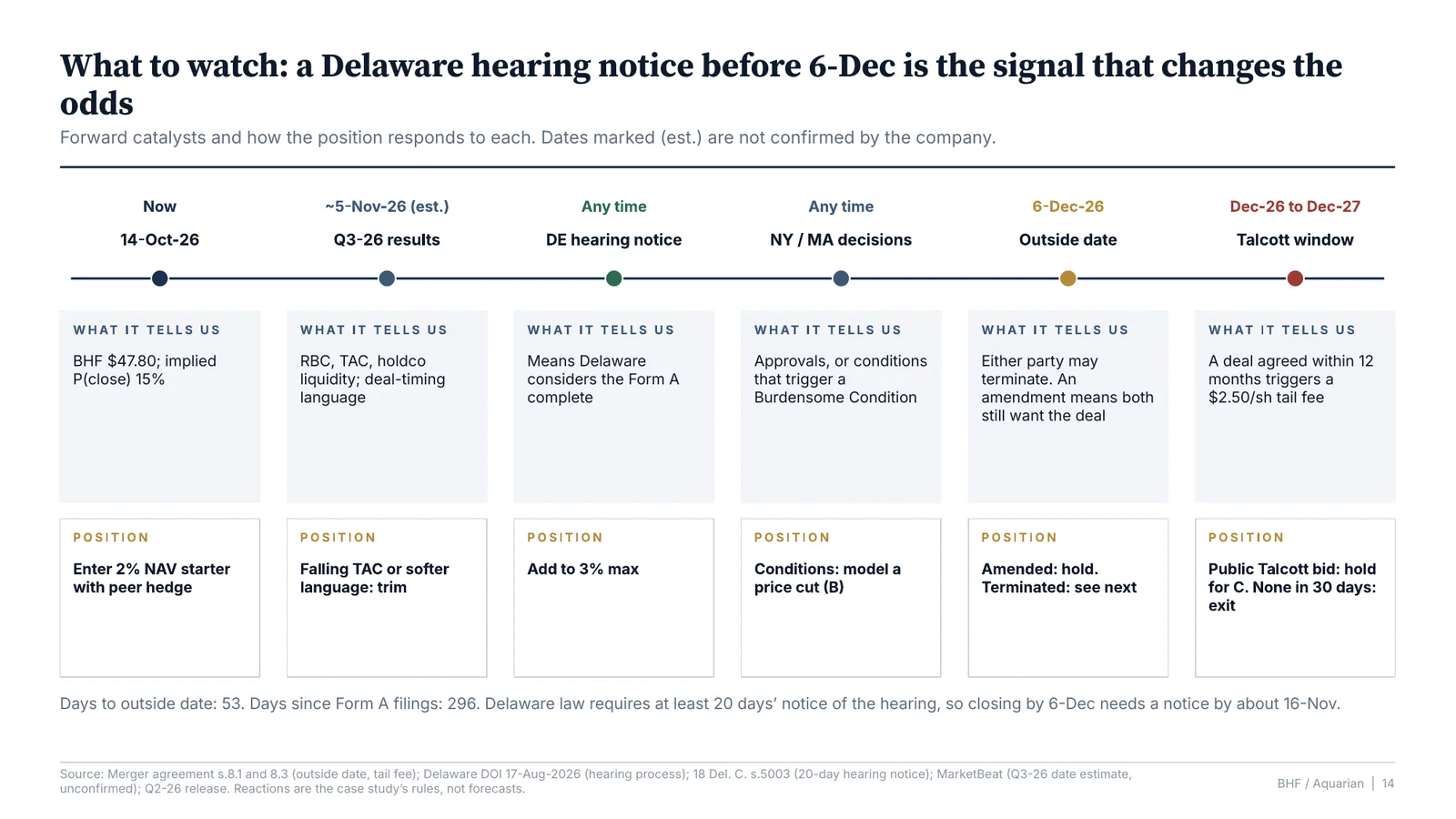
8. Catalysts
| When | Event | What it tells us | Position |
|---|---|---|---|
| Now (14-Oct-26) | BHF $47.80; implied P(close) 15% | Enter 2% NAV starter with the peer hedge | |
| ~5-Nov-26 (est.) | Q3-26 results | RBC, TAC, holdco liquidity; deal-timing language | Falling TAC or softer language: trim |
| Any time | Delaware hearing notice | Delaware considers the Form A complete | Add to the 3% max |
| Any time | NY / MA decisions | Approvals, or conditions that trigger a Burdensome Condition | Conditions: model a price cut (B) |
| 6-Dec-26 | Outside date | Either party may terminate; an amendment means both still want the deal | Amended: hold. Terminated: see below |
| Dec-26 to Dec-27 | Talcott window | A deal agreed within 12 months triggers the $2.50/sh tail fee | Public Talcott bid: hold for C. None within 30 days: exit |
There are 53 days to the outside date. Delaware law (18 Del. C. s.5003) requires at least 20 days’ notice of a Form A hearing, so closing by 6-Dec needs a notice by about 16-Nov.
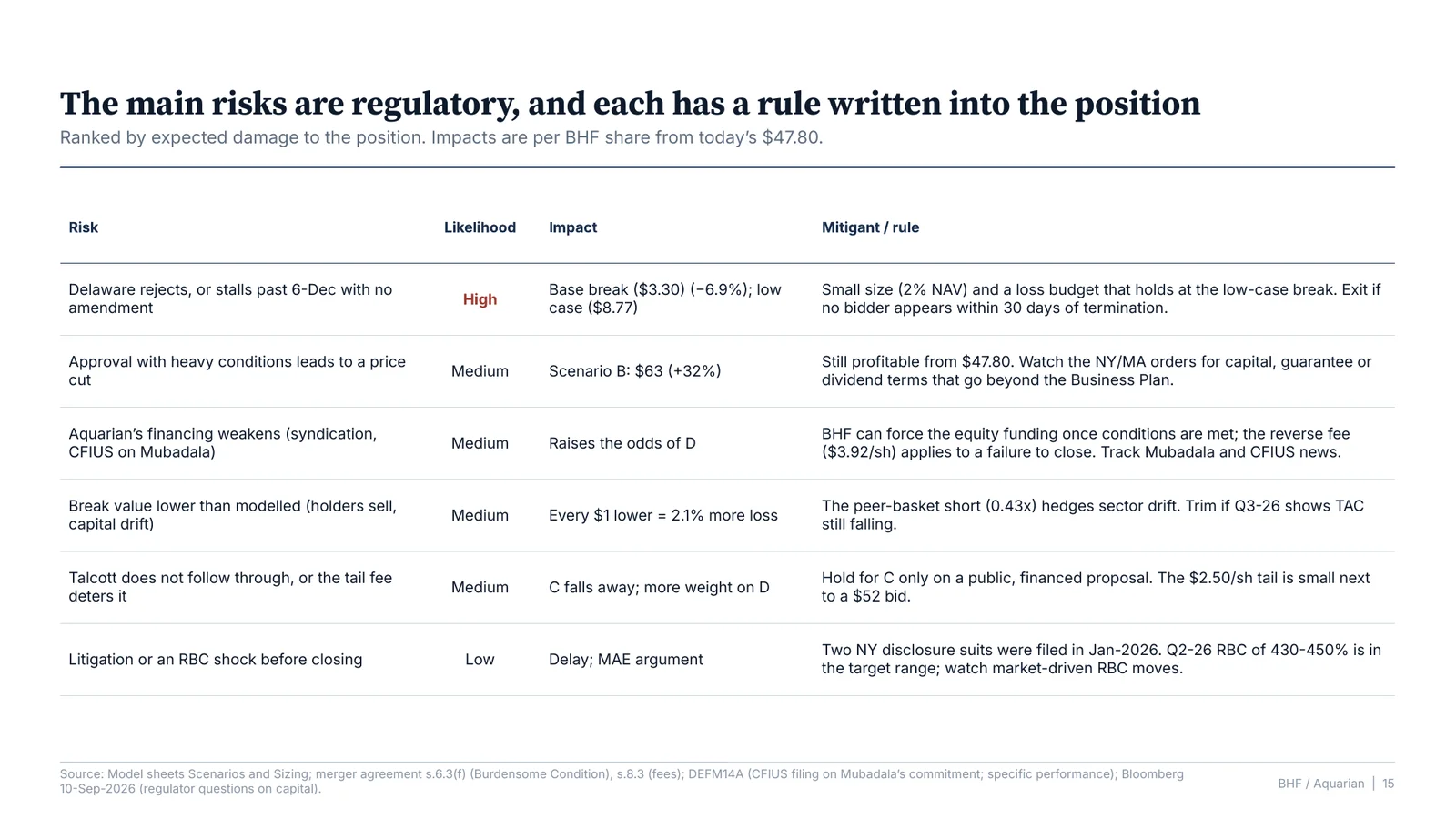
9. Risks and mitigants
| Risk | Likelihood | Impact | Mitigant / rule |
|---|---|---|---|
| Delaware rejects, or stalls past 6-Dec with no amendment | High | Base break -$3.30 (-6.9%); low case -$8.77 | Small size and a loss budget that holds at the low-case break. Exit if no bidder appears within 30 days of termination |
| Approval with heavy conditions leads to a price cut | Medium | Scenario B: $63 (+32%) | Still profitable from $47.80. Watch NY/MA orders for capital, guarantee or dividend terms beyond the Business Plan |
| Aquarian’s financing weakens (syndication, CFIUS on Mubadala) | Medium | Raises the odds of D | BHF can force the equity funding once conditions are met; the reverse fee ($3.92/sh) applies to a failure to close |
| Break value lower than modelled | Medium | Every $1 lower = 2.1% more loss | The peer short hedges sector drift. Trim if Q3-26 shows TAC still falling |
| Talcott does not follow through, or the tail fee deters it | Medium | C falls away; more weight on D | Hold for C only on a public, financed proposal. The $2.50 tail is small next to a $52 bid |
| Litigation or an RBC shock before closing | Low | Delay; MAE argument | Two New York disclosure suits were filed in Jan-2026. Q2-26 RBC of 430-450% is in the target range |
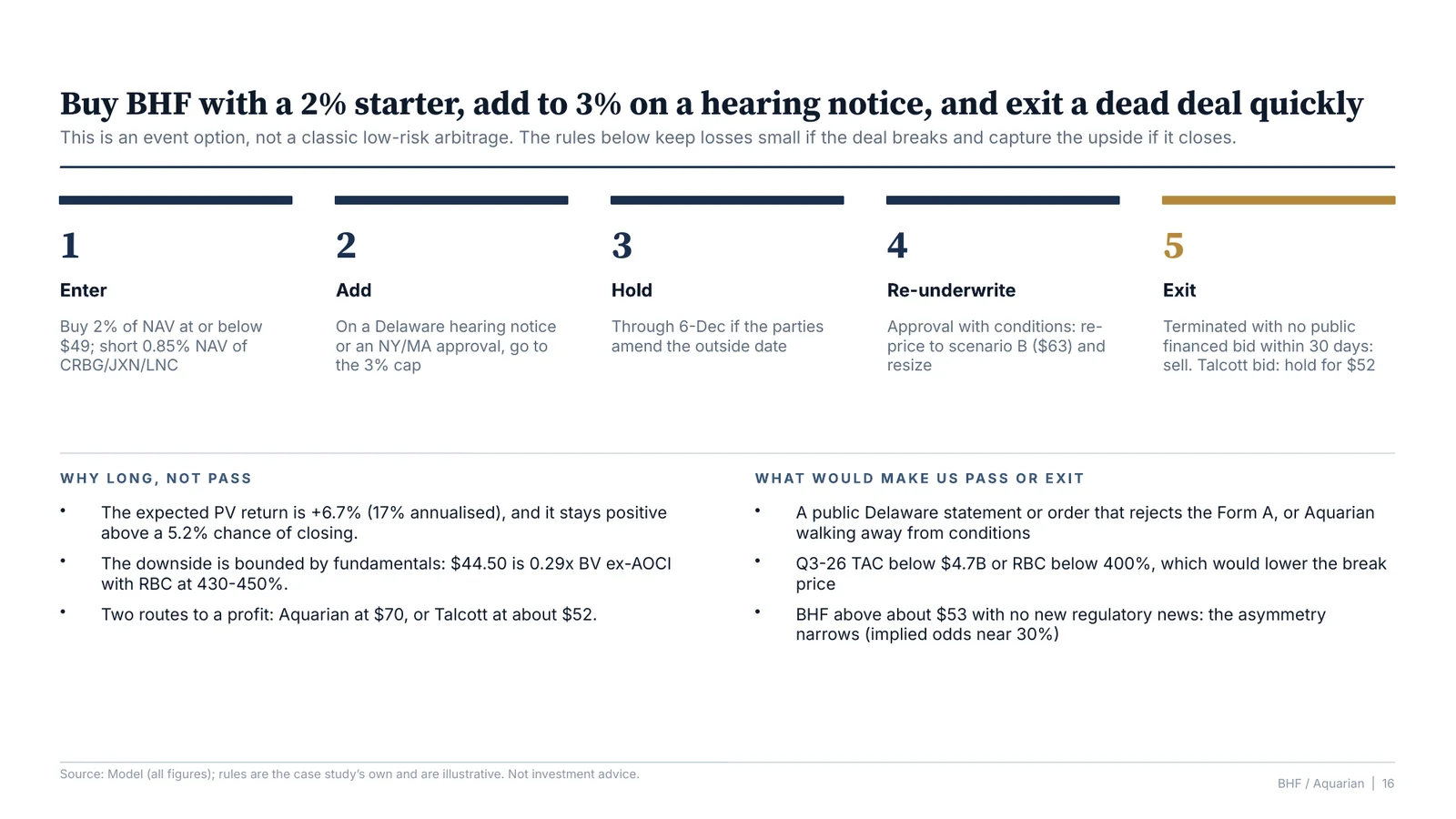
10. Decision rules
- Enter: buy 2% of NAV at or below $49; short 0.85% of NAV of CRBG/JXN/LNC.
- Add: on a Delaware hearing notice or an NY/MA approval, go to the 3% cap.
- Hold: through 6-Dec if the parties amend the outside date.
- Re-underwrite: if approval comes with conditions, re-price to scenario B ($63) and resize.
- Exit: if the deal is terminated with no public financed bid within 30 days, sell. If Talcott bids publicly, hold for about $52.
What would make us pass or exit: a public Delaware statement or order rejecting the Form A, or Aquarian walking away from conditions; Q3-26 TAC below $4.7B or RBC below 400%; BHF above about $53 with no new regulatory news, because the asymmetry narrows (implied odds near a third).
Assumptions and what could not be verified
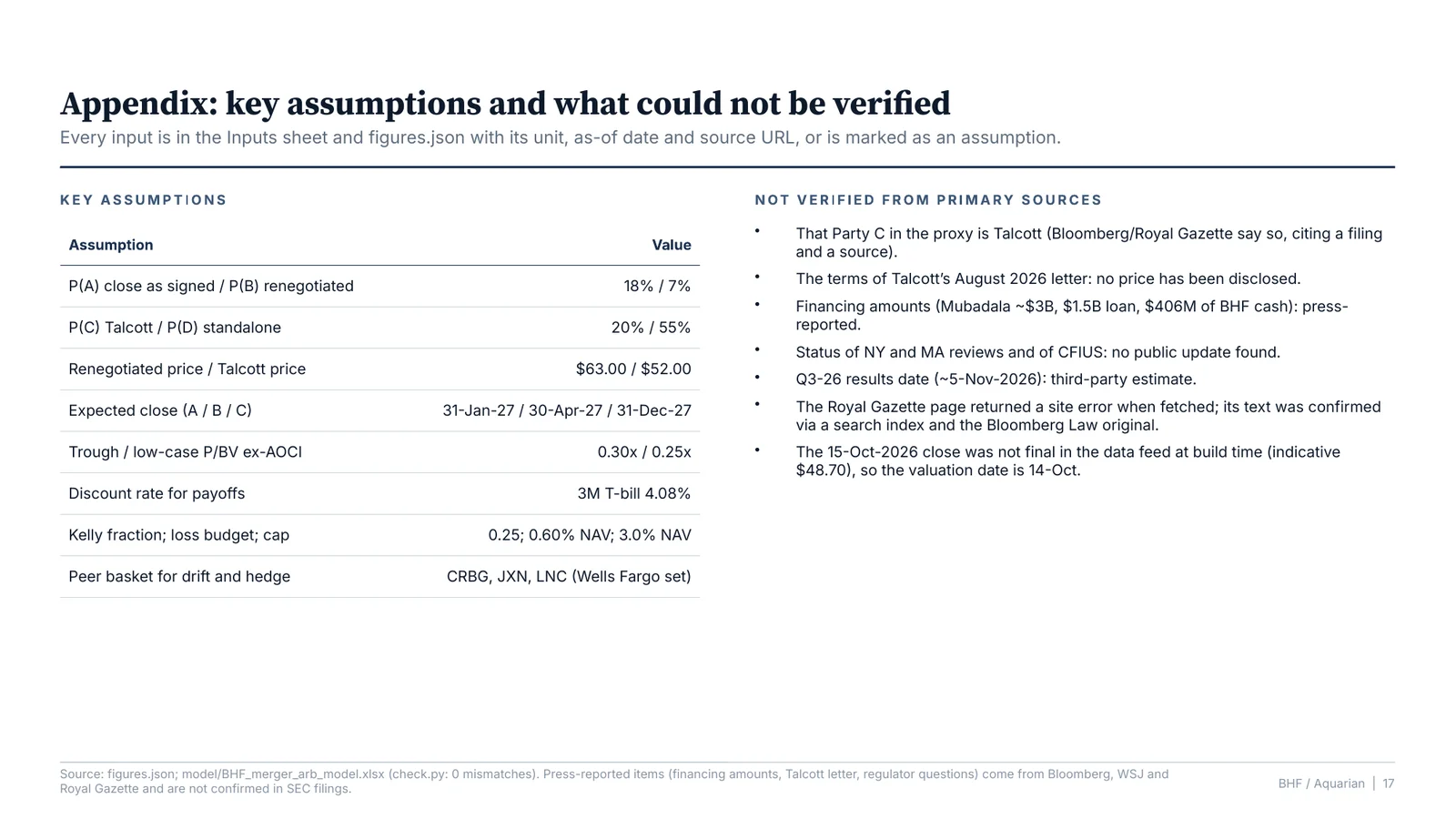
Key assumptions (all flagged in figures.json): P(A) 18%, P(B) 7%, P(C) 20%, P(D) 55%; renegotiated price $63.00 and Talcott price $52.00; expected close dates 31-Jan-27 / 30-Apr-27 / 31-Dec-27; trough and low-case multiples 0.30x and 0.25x BV ex-AOCI; payoffs discounted at the 3-month T-bill (4.08%); quarter-Kelly, a 0.60% NAV loss budget and a 3.0% cap; CRBG/JXN/LNC as the peer basket.
Not verified from primary sources:
- That Party C in the proxy is Talcott (Bloomberg and the Royal Gazette say so).
- The terms of Talcott’s August-2026 letter. No price has been disclosed.
- Financing amounts (Mubadala ~$3B, $1.5B loan, $406M of BHF cash). These are press-reported.
- Status of the NY and MA reviews and of CFIUS. No public update was found.
- The Q3-26 results date (~5-Nov-2026), which is a third-party estimate.
- The Royal Gazette article (14-Oct-2026) returned a site error when fetched. Its text was confirmed via a search index and the Bloomberg Law original.
- The 15-Oct-2026 close was not final in the data feed at build time (indicative $48.70), so the valuation date is 14-Oct-2026.