Independent M&A case study · Potential combination under review · Public information only
● In progress · updated as filings arrive
SpaceX / Tesla: pricing a merger that is still under review
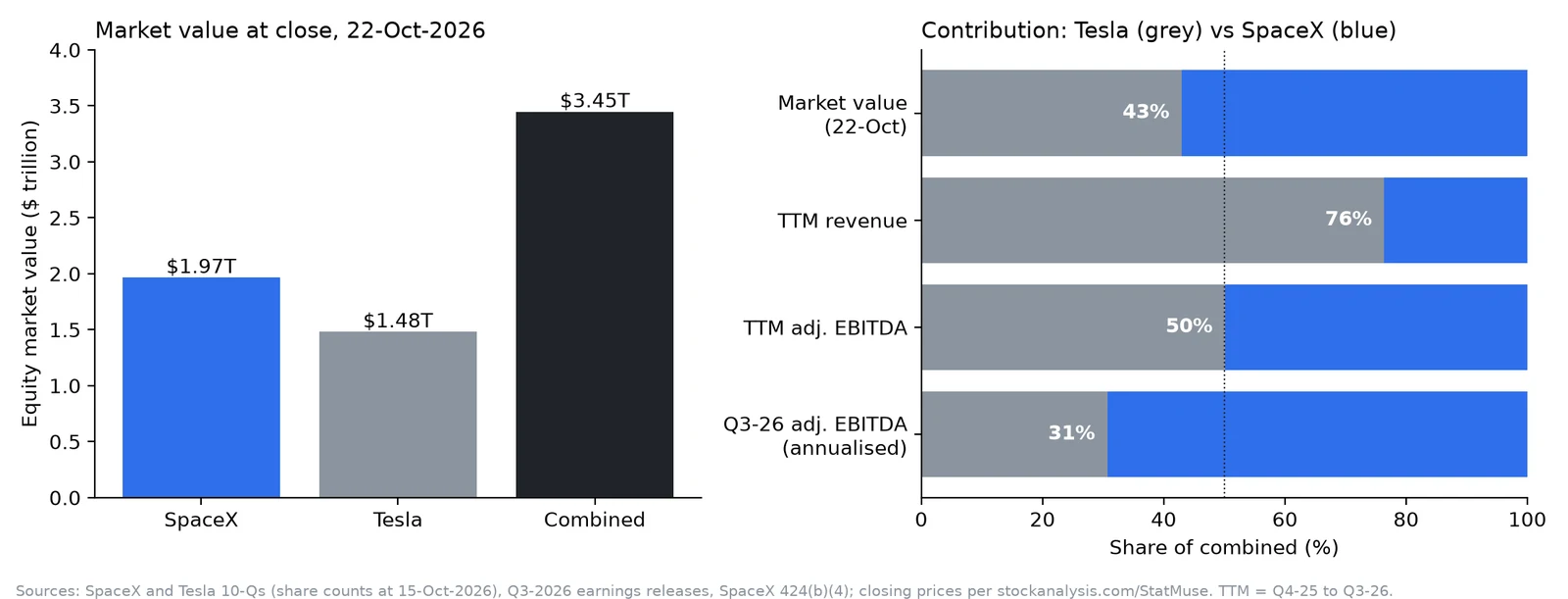
No deal has been agreed. Both boards have formed special committees to evaluate a potential combination, and no terms are public. At the 22-Oct-2026 close the two companies were worth $3.45T together, and a zero-premium swap is 2.588 SPCX per TSLA. My view: a deal is plausible but not close, and the premium, not the logic, will decide it. Tesla's shareholder vote, not antitrust, is the binding constraint.
Status
Under review: special committees only
No agreement, terms or filing with a ratio
Combined market value
$3.45T
SpaceX $1.97T · Tesla $1.48T (22-Oct close)
Market ratio
2.588x
SPCX per TSLA · Tesla holders 43.0% at no premium
Hypothetical 20–35% premium
$296B–$518B
Value synergies must earn back for SpaceX holders
Not prepared for, reviewed by, or affiliated with SpaceX, Tesla, their advisors, or any employer or client. Not investment advice. All figures in US$. Every exchange ratio, premium and ownership split is a hypothetical built from public figures; no transaction has been agreed.
Bottom line
Status: exploratory talks only. My view is that a deal is plausible but not close, and that the premium, not the logic, will decide it.
- Confirmed: both boards have formed special committees (Tesla 10-Q and SpaceX 10-Q, 22-Oct-2026). Musk has recused himself from them and called a combination “a good idea” (SpaceX Q3 call, 20-Oct). SpaceX says any deal also needs the approval of its “controlling shareholder”, which is Musk. Not public: terms, structure, advisors, committee members and timetable.
- At 22-Oct closing prices the two companies are worth $3.45T together: SpaceX $1.97T and Tesla $1.48T. A zero-premium swap is 2.588 SPCX per TSLA and would give Tesla holders 43.0% of the combined company.
- A premium is a straight value transfer unless synergies exist. The 20-35% that RBC and JPMorgan say Tesla holders will want works out to $296B-$518B of value that has to come back as capitalised synergies before SpaceX holders are made whole. At 30%, that is about $22B a year after tax on a 20x multiple (my assumption), which is more than Tesla’s entire TTM operating expense base of $16.5B.
- Contribution analysis justifies anywhere from no premium to about 33%, depending on which earnings you believe. Tesla supplies 76% of TTM revenue and 50% of TTM adjusted EBITDA, but only 31% of Q3 annualised adjusted EBITDA.
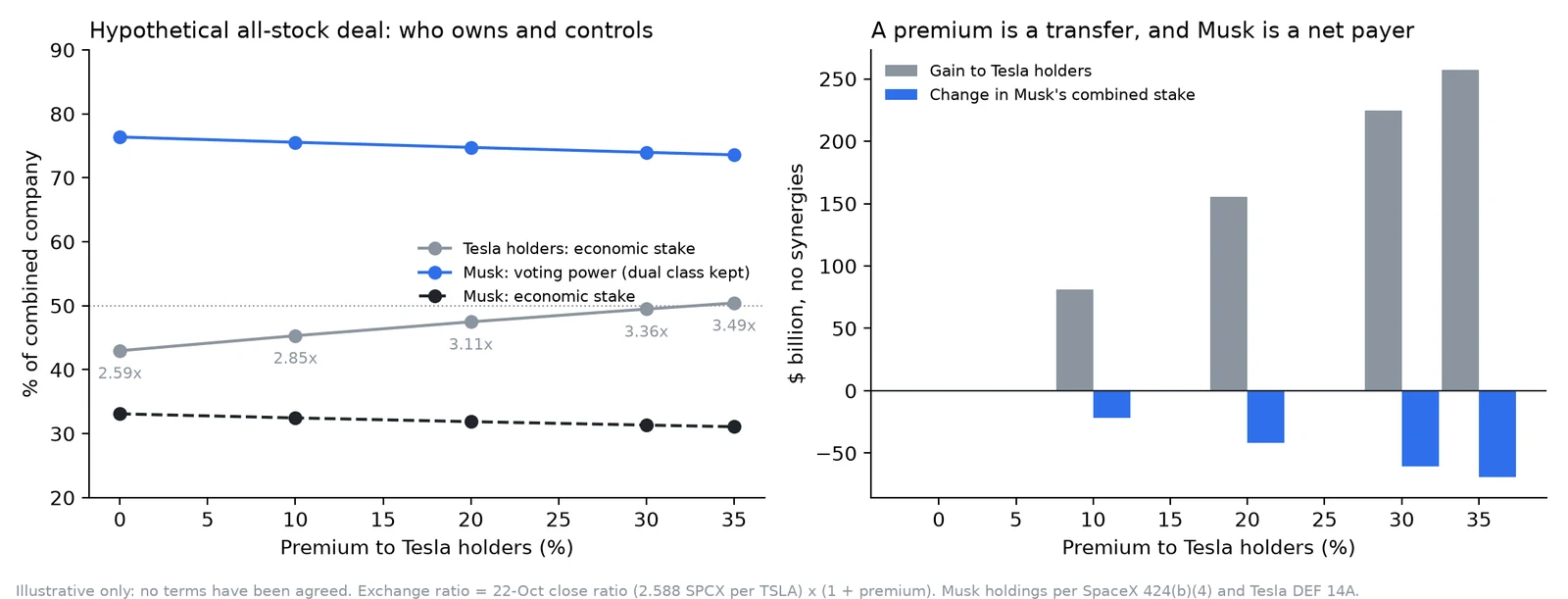
- Musk keeps control in any SpaceX-led structure. If SpaceX keeps its 10-vote Class B shares, I estimate his voting power at 74-76% of the combined company, against ~20% at Tesla as of October 2026. His economic interest runs the other way. He owns ~45% of SpaceX and ~18% of Tesla (~18% is his 699.6M shares held over all 3,953M Tesla shares outstanding; the 19.8% beneficial-basis figure in §6 excludes the 423.7M unearned award shares from the share count), so every point of premium costs him money: about -$61B at a 30% premium before synergies.
- The binding constraint is Tesla’s vote: a majority of all outstanding shares, by Musk’s own description. That is a governance problem, not an antitrust one.
1. Where it stands
| Date (2026) | Event | Status |
|---|---|---|
| 2-Feb | SpaceX completes its acquisition of xAI Holdings (which owns X) in a common-control share exchange | Filed (SpaceX 10-Q) |
| 12-Mar | Tesla completes a ~$2.0B purchase of SpaceX Class A shares, converted from an xAI Series E commitment | Filed (Tesla DEF 14A) |
| 11/12-Jun | SpaceX prices its IPO at $135 (555.6M shares, ~$75B raised, $1.77T valuation); first-day close $160.95 | Filed / reported |
| 29-Sep | Tesla signs $30B of undrawn credit facilities that define a “Specified Merger” with a Musk-controlled entity and pre-approve one, subject to investment-grade ratings | Filed (8-K; 10-Q Ex. 10.1-10.3) |
| 20-Oct | SpaceX Q3 call: Musk says special committees exist, he is “a conflicted party”, there are no agreed terms, and calling the deal a certainty would be “overstating it” | Reported (transcripts) |
| 21-Oct | Tesla Q3 call; no questions taken on the merger | Reported |
| 22-Oct | Tesla 10-Q (Part II, Item 5) and SpaceX 10-Q confirm the committees in writing | Filed |
| 22-Oct | Reuters (sources): SpaceX made the approach; advisors are hired; the options include SpaceX buying Tesla or a new holding company; all-stock is under consideration; Musk’s public comments are a “mess” for the process | Reported, unverified |
| 3-Dec | Tesla annual meeting (proxy shows no merger proposal) | Filed |
There is no merger agreement, no 8-K under Item 1.01, no Rule 425 filing, no proxy or S-4, and no fairness opinion. Bloomberg (as relayed by The Next Web) reports a push to announce by the first half of 2027; Barclays has suggested an announcement could come before the December meeting. Both are unverified.
2. Why do it
The stated logic is shared AI and hardware. Musk named software, chip design, robotics and connectivity, and pointed to Terafab, the joint chip plant planned for Grimes County, Texas (~$16.8B first phase, per company statements). The companies are already connected in four ways:
- Commercial: Tesla recognised $626M of Megapack revenue from SpaceX in 9M-2026. It held $729M of receivables and $648M of deferred revenue from SpaceX at 30-Sep.
- Capital: Tesla’s SpaceX stake was carried at $2,865M at 30-Sep, at fair value. It is subject to IPO sale restrictions until December 2026.
- Joint projects: Terafab, a Roadster built with SpaceX hardware, and Starlink at Superchargers.
- People: Musk is CEO of both. Ira Ehrenpreis sits on both boards; Tesla’s proxy says he joined SpaceX’s board in Feb-2026.
My read: the strategic overlap is real, but most of it is already available by contract. The test for a merger is the incremental value over arm’s-length agreements. That means a single cost of capital for SpaceX’s capex bill, less related-party friction, and one CEO’s time, set against the loss of Tesla’s independent governance. Musk’s own phrase for the current arrangement was “an odd kabuki dance”. That argues for simplification, but it also shows how much the merger itself is about control.
3. Standalone valuation: two very expensive stocks
| Equity value / metric (22-Oct) | SpaceX | Tesla |
|---|---|---|
| Shares outstanding (M) | 13,581 (8,247 A + 5,335 B) | 3,953 |
| Market value | $1,966B | $1,481B |
| TTM revenue (Q4-25 to Q3-26) | $32.0B → 61.4x | $103.6B → 14.3x |
| TTM adjusted EBITDA | $14.9B → 131.5x | $15.0B → 98.7x |
| Q3-26 adjusted EBITDA × 4 | $35.2B → 55.8x | $15.6B → 94.9x |
| TTM GAAP net income | n/m (9M-26 loss of $0.4B) | $3.2B → 460x |
| Q3-26 capex vs adjusted EBITDA | $19.6B vs $8.8B | $4.7B vs $3.9B |
| Cash and investments, 30-Sep | $89.9B (cash + marketable securities) | $45.4B |
Multiples are equity value over company metrics (enterprise values are not computed). Adjusted EBITDA is each company’s non-GAAP measure, and the two definitions differ. SpaceX TTM figures are FY-2025 (as recast in the prospectus) minus 9M-2025 plus 9M-2026.
Neither stock trades on near-term earnings. SpaceX’s case is momentum: Q3 revenue grew 161% year on year to $14.6B, SI (AI) segment revenue was $7.6B, and it reported its first quarterly net income as a public company ($4.4B, helped by $1.0B of other income). Its weakness is cash: $48.1B of capex in nine months. Tesla’s case is optionality on autonomy and robotics on top of a flat core: Q3 revenue was $28.0B (-0.2% y/y) and GAAP net income $0.8B. For the exchange ratio that matters because there is no anchor DCF either side would accept. The negotiation will fall back on market prices and contribution.
4. Exchange-ratio math (hypothetical)
Market ratio = TSLA / SPCX = $374.58 / $144.75 = 2.588x (unaffected, at the 20-Oct close before the call: $373.71 / $147.79 = 2.529x). New SPCX shares = 3,952.8M × ratio. Tesla holders’ stake = new shares / (13,581M + new shares). “Gain to Tesla” assumes the combined company is worth the 22-Oct $3,446B, with no synergies.
| Premium | Ratio (SPCX per TSLA) | New SPCX shares (M) | Tesla holders’ stake | Headline premium | Gain to Tesla holders, no synergies | Synergies SpaceX holders need to break even | Musk voting power* | Musk economic stake | Change in Musk’s wealth, no synergies |
|---|---|---|---|---|---|---|---|---|---|
| 0% | 2.588 | 10,229 | 43.0% | $0B | $0B | $0B | 76.4% | 33.1% | $0B |
| 10% | 2.847 | 11,252 | 45.3% | $148B | $81B | $148B | 75.5% | 32.5% | -$22B |
| 20% | 3.105 | 12,275 | 47.5% | $296B | $156B | $296B | 74.7% | 31.9% | -$42B |
| 30% | 3.364 | 13,297 | 49.5% | $444B | $224B | $444B | 74.0% | 31.3% | -$61B |
| 35% | 3.494 | 13,809 | 50.4% | $518B | $257B | $518B | 73.6% | 31.1% | -$69B |
*Assumes SpaceX acquires Tesla, keeps its dual-class charter, and issues Class A shares (1 vote) to Tesla holders. Musk’s SpaceX position is taken from the prospectus (849.5M A plus 5,219.1M B, excluding 350M B options) and applied to the current share count (15-Oct-2026 cover pages). On that basis he has ~86% of SpaceX’s votes as of October 2026. The prospectus gave 82.4% at the IPO, and the press says “about 85%”. Tesla: 699.6M shares (DEF 14A); the 423.7M unearned award shares are excluded.
Three things stand out:
- The 20-35% premium range is very large in dollars. About half of the headline premium is funded by Tesla holders themselves, because the SpaceX shares they receive are diluted. That is why the “gain” column is roughly half the “headline” column.
- Contribution brackets the fight (Figure 1). Tesla is 43% of market value, 50% of TTM adjusted EBITDA and 31% of run-rate adjusted EBITDA. On TTM EBITDA, Tesla holders deserve ~50%, which is a ~33% premium. On Q3 run-rate, they would get less than the market already gives them. Expect Tesla’s committee to argue TTM and SpaceX’s to argue run-rate.
- Control and economics pull Musk in opposite directions. In a SpaceX-led deal he controls the combined company at any plausible premium, but he personally pays for the premium (Figure 2). A low premium serves his wealth, and that is exactly why Tesla’s committee has to be seen to bargain hard.
Not reconciled: Reuters quoted an “illustrative 0.7 of one SpaceX share” ratio attributed to Barclays, with Musk at 57-58% of the vote. That ratio cannot be squared with share prices of $144.75 and $374.58, and those voting figures do not match a dual-class SpaceX survivor. They may assume a different structure (for example a one-share-one-vote holding company, where Musk would hold only ~31-33%). I have not used them.
5. Structure and consideration
- SpaceX buys Tesla (reported option). Tesla becomes a subsidiary and SpaceX’s dual-class charter survives. Musk’s control is kept, and SpaceX’s own approvals are a formality, because Musk controls its vote.
- A new holding company (reported option). The holdco’s voting structure becomes a term in its own right: a dual-class holdco keeps Musk in control, while a single-class holdco would cost him control. Tesla’s new credit agreements pre-approve Tesla becoming a wholly owned subsidiary of a holding company controlled by “Permitted Holders” (Musk and named trusts).
- Consideration: all-stock is the reported base case. SpaceX has ~$90B of cash and securities, but against $19.6B of capex a quarter, cash consideration is unlikely to be a large part.
- Tesla’s debt: the 29-Sep facilities ($20B delayed-draw term loan, $8B five-year revolver, $2B 364-day revolver, all undrawn) treat a Musk-controlled combination as a permitted transaction only if Tesla keeps investment-grade ratings from two of Moody’s, S&P and Fitch. The test runs from the first public announcement of an agreement through day 90, and is extended while any rating is on watch. If it fails, the deal becomes a change in control. Tesla’s reported ratings are Baa3, BBB and BBB (not verified with the agencies), so Moody’s is one notch from the line.
7. Regulatory and approval path (my reading; nothing has been filed)
| Approval | Why | Gating? |
|---|---|---|
| Tesla special committee, board, majority of outstanding shares | Charter and statute; Musk is a minority holder at Tesla | Yes |
| SpaceX special committee, board, Musk as controlling shareholder | Disclosed in the SpaceX 10-Q | No (Musk controls it) |
| SEC: S-4 / joint proxy, fairness opinions | Stock consideration; whether Rule 13e-3 applies is a question for counsel | Timing |
| HSR (FTC/DOJ) | Musk does not control Tesla under HSR’s 50% test, so a filing is likely required; few horizontal overlaps | Probably not |
| China (SAMR) and other foreign merger control | Tesla’s Shanghai plant; Reuters reports Beijing scrutiny of combining it with a US defence contractor | Possible delay or leverage |
| FCC | If SpaceX survives, its licences need not transfer; a holdco structure may need transfer-of-control consents | Structure-dependent |
| DoD / NASA / national security | SpaceX’s contracts stay with SpaceX; Congressional scrutiny is likely (Sen. Booker); Reuters flags foreign-ownership and China-exposure questions | Political rather than legal |
| Tesla lenders | Rating test on the 29-Sep facilities | Indirect |
8. Market reaction
From the 20-Oct close (just before the call) to the 22-Oct close, SPCX fell 2.1% ($147.79 → $144.75) and TSLA rose 0.2% ($373.71 → $374.58). The ratio widened from 2.529x to 2.588x: Tesla outperformed by 2.3%. The path was volatile. On 21-Oct SPCX rose 7.8% and TSLA 3.4%, after SpaceX’s results and Musk’s comments. On 22-Oct SPCX fell 9.1% and TSLA 3.1%, on a day when large-cap tech also fell (NVDA -4.4%, AMD -8.1%). Read literally, a 2.3% relative move is consistent with the market pricing a low chance of a sizeable premium. But two days of noisy prices and SpaceX’s own earnings make that unreliable, and I would not build a probability on it.
9. Risks
- No deal. Musk himself warns against assuming certainty. The committees may decline, or settle for contracts such as a Terafab cost-sharing agreement instead.
- Premium too low, vote fails. Because unvoted shares count against, broker non-votes and index-fund policies matter more than headline support.
- Premium too high, SpaceX holders are diluted for synergies that are mostly available by contract already.
- Litigation: in Texas the rules are untested, and the 3% threshold narrows derivative suits but not direct class claims.
- Political and foreign-regulatory risk: China leverage over Tesla Shanghai, midterm-driven oversight (3-Nov), and Starlink’s role in Ukraine.
- Credit: a ratings slip during the test window turns $30B of Tesla standby liquidity into a default trigger.
- Valuation: both stocks trade at 95-130x adjusted EBITDA, so the exchange ratio can move 10% in a week, as it nearly did in the week of 20 Oct.
10. What to watch
- An 8-K (Item 1.01 or 8.01) or Rule 425 filing: the first terms, structure and ratio.
- Whether Tesla adopts a majority-of-the-minority condition, or files a Texas §21.4161 petition on its committee’s independence.
- The names of the committee members and advisors, and whether Ehrenpreis recuses himself.
- Rating actions on Tesla (Moody’s Baa3 is the swing vote).
- The Tesla annual meeting (3-Dec) and the December expiry of the lock-up on Tesla’s SpaceX shares.
- Positioning: none until there are terms. Once a fixed ratio R is announced, the spread is R × SPCX - TSLA. Whether it is worth trading depends on the vote math above, not on antitrust.
What could not be verified
- Committee members, advisors, formation dates and any term sheet: none are public.
- Reuters’ and Bloomberg’s sourced reporting (SpaceX made the approach; the structures under consideration; the H1-2027 target) is unconfirmed by the companies.
- The Barclays “0.7” illustrative ratio and the 57-58% Musk vote estimates could not be reconciled with share prices or structures (see §4).
- Musk’s current SpaceX holdings: I used prospectus figures on the current share count (15-Oct-2026 cover pages), so his ~86% voting estimate may be slightly off.
- Tesla’s and SpaceX’s credit ratings are from secondary reports.
- The Tesla charter’s vote requirement and the 2025 adoption of the 3% derivative threshold rely on Musk’s statement and secondary summaries; I did not read the charter itself.
- Whether TBOC §21.606, Rule 13e-3 or the pay-award change-in-control clauses apply depends on the final structure. Those are legal questions, and I have flagged them without answering them.
- The synergy multiple (20x after tax) is an assumption used only for scale.
Sources (all accessed October 2026)
- Tesla, Form 10-Q for Q3-2026 (filed 22-Oct-2026): Part II Item 5 (special committee); Notes 1, 2 and 13; cover share count; Ex. 10.1 (credit agreement definitions). https://www.sec.gov/Archives/edgar/data/1318605/000162828026066775/tsla-20260930.htm
- Space Exploration Technologies Corp., Form 10-Q for Q3-2026 (filed 22-Oct-2026): special committee language, xAI merger, share counts. https://www.sec.gov/Archives/edgar/data/1181412/000162828026066880/spcx-20260930.htm
- SpaceX Q3-2026 earnings release, 8-K Ex. 99.1 (20-Oct-2026). https://www.sec.gov/Archives/edgar/data/1181412/000162828026066482/spaceexplorationtechnologi.htm
- Tesla Q3-2026 Update, 8-K Ex. 99.1 (21-Oct-2026). https://www.sec.gov/Archives/edgar/data/1318605/000162828026066738/exhibit9914.htm
- Tesla 8-K, credit agreements (29-Sep-2026). https://www.sec.gov/Archives/edgar/data/1318605/000162828026063820/tsla-20260929.htm
- Tesla 2026 proxy statement, DEF 14A (19-Oct-2026): beneficial ownership, pay-award terms, related-party transactions, annual meeting date. https://www.sec.gov/Archives/edgar/data/1318605/000110465926116700/tm267596-1_def14a.htm
- SpaceX IPO prospectus, 424(b)(4) (Jun-2026): Musk holdings, 82.4% voting power, Texas incorporation, TBOC §21.606. https://www.sec.gov/Archives/edgar/data/1181412/000162828026042639/spaceexplorationtechnologi.htm
- Reuters, “Musk’s SpaceX prices record $75 billion IPO at $135 a share” (11-Jun-2026). https://www.reuters.com/world/musks-spacex-prices-record-75-billion-ipo-135-share-2026-06-11/
- Reuters, “SpaceX surges past $2 trillion in Nasdaq debut” (12-Jun-2026). https://www.reuters.com/legal/transactional/after-record-ipo-musks-spacex-faces-next-test-market-debut-2026-06-12/
- TechCrunch, “SpaceX and Tesla boards form special committees to review merger” (20-Oct-2026). https://techcrunch.com/2026/10/20/spacex-and-tesla-boards-form-special-committees-to-review-merger/
- BBC, “Elon Musk confirms he is considering merging Tesla and SpaceX” (20/21-Oct-2026). https://www.bbc.com/news/articles/cmlyl09xjke4o
- Reuters via Investing.com, “Wall St sees Tesla-SpaceX merger as inevitable, but split on price” (21-Oct-2026). https://www.investing.com/news/stock-market-news/teslaspacex-deal-wall-st-says-inevitable-but-musk-says-its-not-certain-4962374
- TheFly via TipRanks, “JPMorgan lays out potential SpaceX, Tesla merger terms” (21-Oct-2026). https://www.tipranks.com/news/the-fly/jpmorgan-lays-out-potential-spacex-tesla-merger-terms-thefly-news
- Reuters via US News, “SpaceX says potential Tesla merger would need Musk’s approval” (22-Oct-2026). https://money.usnews.com/investing/news/articles/2026-10-22/spacex-says-tesla-merger-would-need-musks-approval
- Reuters (exclusive) as summarised by The Next Web, “Musk’s backing for a SpaceX-Tesla merger rattled insiders” (22-Oct-2026), including the Bloomberg reporting. https://thenextweb.com/news/spacex-tesla-merger-musk-insiders-reuters
- Reuters via Investing.com, “Analysis: Musk’s political baggage clouds prospects for SpaceX-Tesla deal” (22-Oct-2026). https://www.investing.com/news/stock-market-news/analysismusks-political-baggage-clouds-prospects-for-spacextesla-deal-4965229
- Fortune, “The biggest hurdle to a SpaceX merger with Tesla isn’t Elon Musk. It’s Tesla’s shareholders” (22-Oct-2026). https://fortune.com/2026/10/22/biggest-hurdle-spacex-merger-tesla-elon-musk-shareholders/
- Cape Fear Advisors, “Tesla-SpaceX Merger: What Tesla’s Lenders Wrote” (22-Oct-2026), used as a secondary read of the credit agreements and ratings, cross-checked against Ex. 10.1. https://capefearadvisors.substack.com/p/spacex-and-tesla-adding-it-up-the-25a
- CNBC, “Musk’s 2018 Tesla pay package must be restored, Delaware court rules” (19-Dec-2025). https://www.cnbc.com/2025/12/19/musk-tesla-pay-delaware-supreme-court.html
- Texas SB 29 (89th Leg., 2025), enrolled text. https://capitol.texas.gov/tlodocs/89R/billtext/pdf/SB00029F.pdf
- Closing prices: stockanalysis.com (SPCX history, https://stockanalysis.com/stocks/spcx/history/) and StatMuse (TSLA, https://www.statmuse.com/money/ask/tesla-stock-price-october-2026-chart).