Trading terminal · Python · PySide6 · Jun 2026

Crypto Quant Desk
A desktop trading terminal for a Kraken spot account, built so I can monitor, trade and stress my own book in one window, with the risk work a desk would do and Kraken's own app does not.
Why: Kraken's dashboard shows balances and orders. It does not show portfolio risk, true cost basis, time-weighted performance or what a past crash would do to the book you hold today. Crypto Quant Desk adds all of that to a full order terminal, across six pages: Portfolio, Markets, Trading, Signals, Risk and Insight. You can drag, tab, float and resize every panel, and the app saves each page's layout.
Every number comes from a pure, tested engine fed only by Kraken data. The UI displays and the optional AI analyst narrates, but neither one computes a figure. Trading starts in paper mode. No code path leads from a signal to an order, and no code path leads to a withdrawal.
Stack: Python 3.12+, PySide6 (Qt), Qt Advanced Docking System, pandas, numpy, pydantic, pyqtgraph, Kraken REST + WebSocket v2. Runs on Windows (primary, with an installer) and macOS. CI on Windows and macOS for Python 3.12 and 3.13.
548
tests
6
pages
4
VaR models, each backtested
4
crash replays
Features
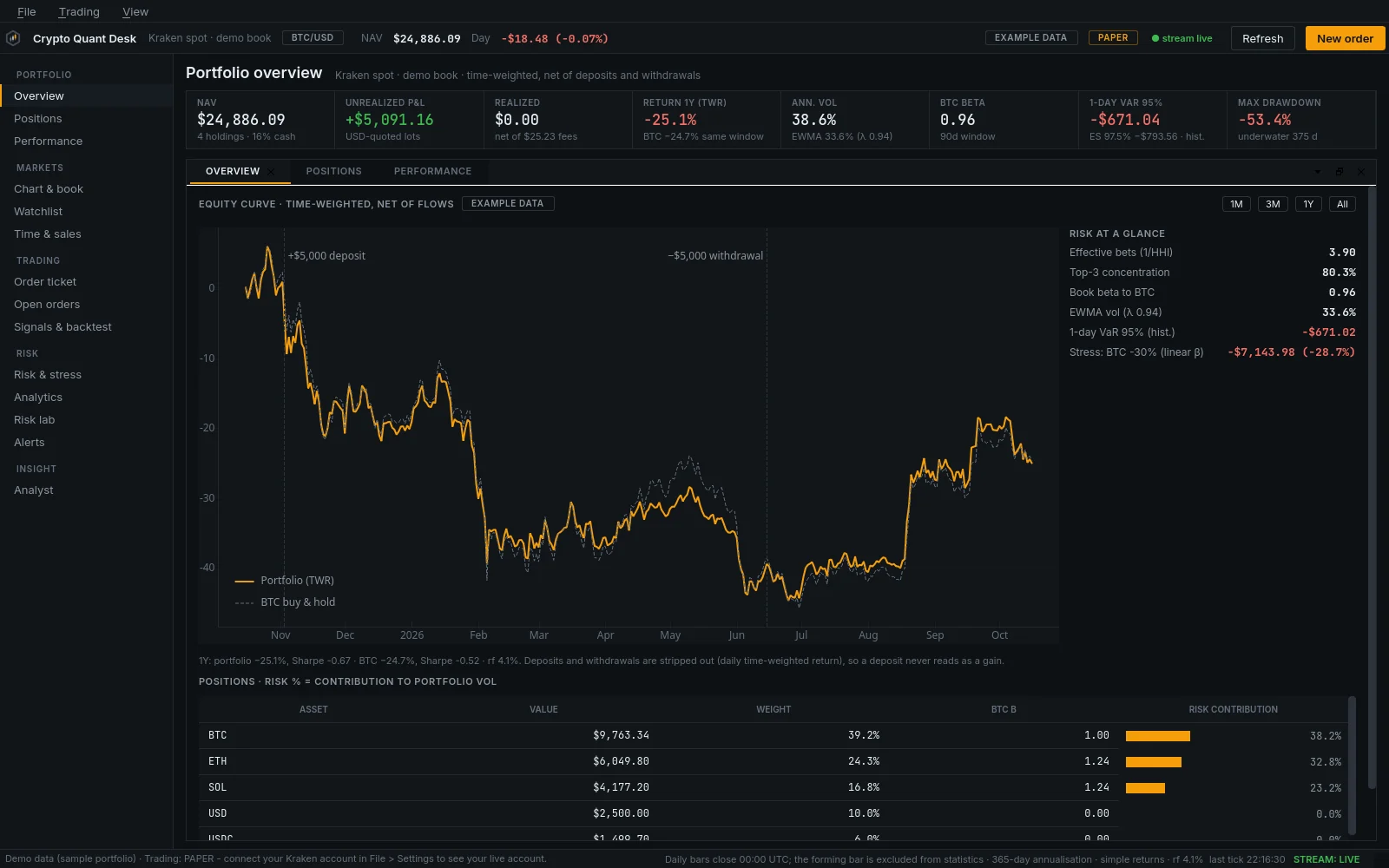
Portfolio overview
Time-weighted equity curve against BTC buy-and-hold with deposits and withdrawals stripped out, risk at a glance and each holding's share of portfolio vol.
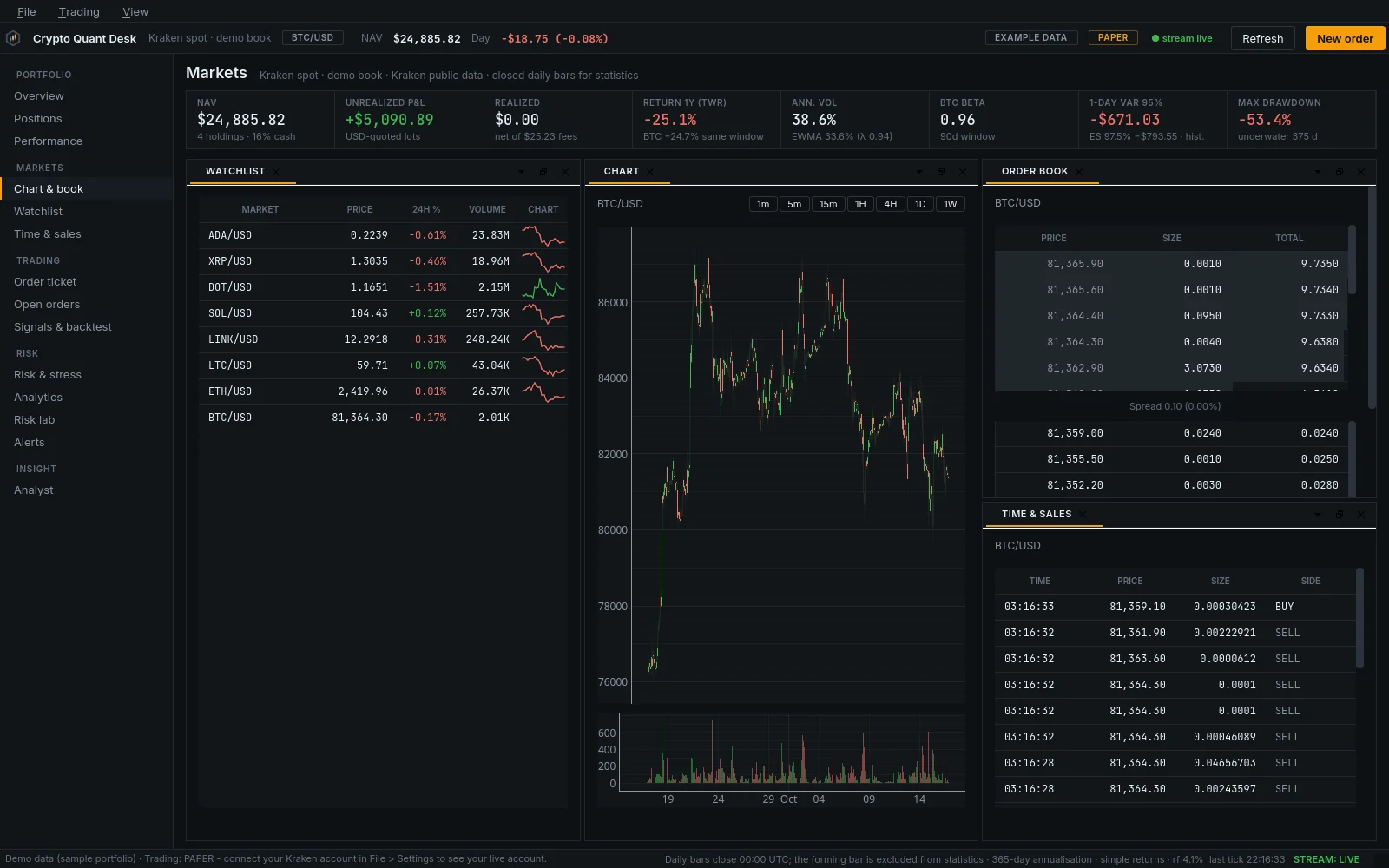
Markets
Watchlist with sparklines, candlestick chart with volume, live depth ladder and time and sales, all from Kraken public data.
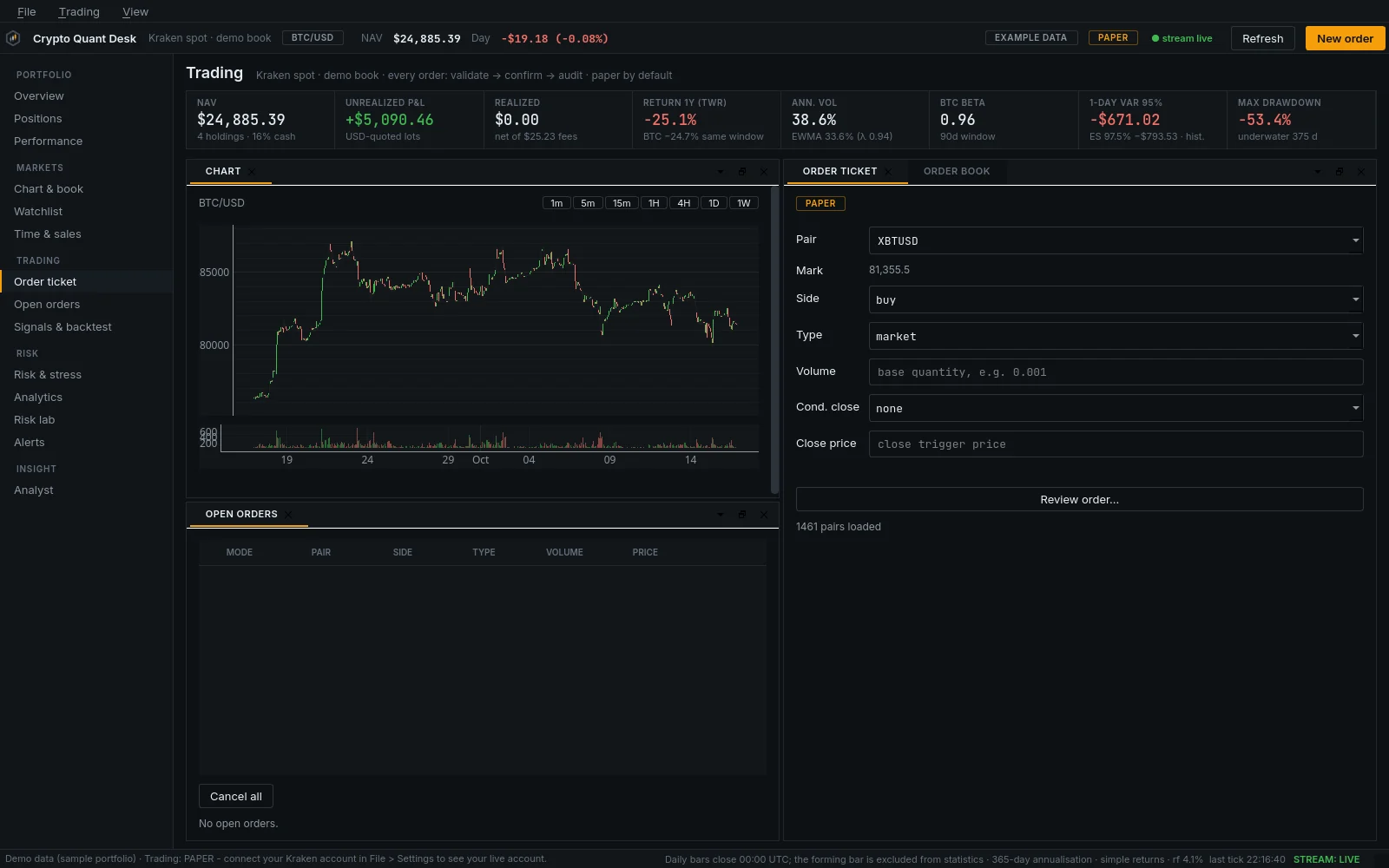
Trading
Order ticket for every Kraken spot order type. Paper by default, a confirm dialog on every order, a max-order cap re-checked at send, and an audit log.
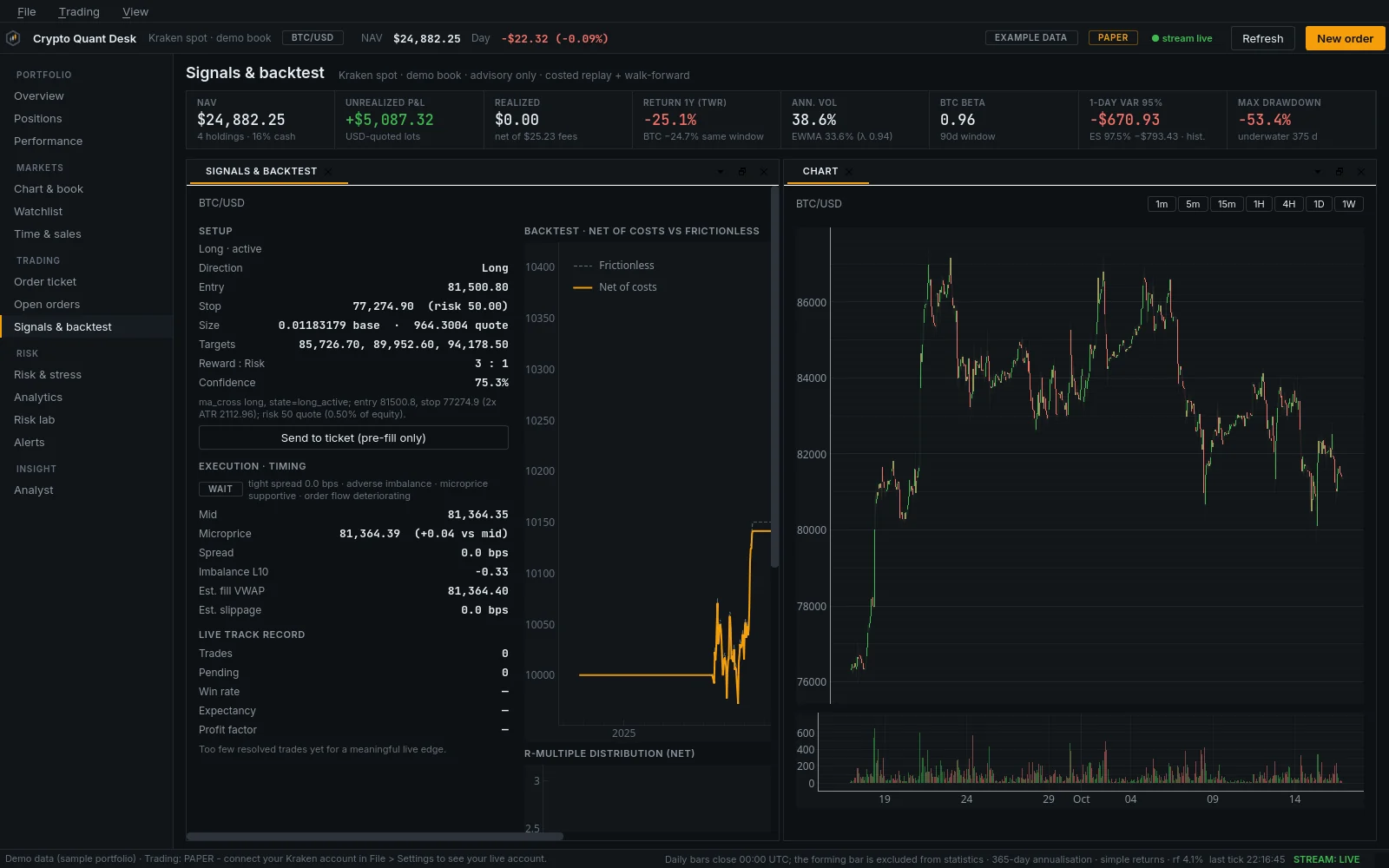
Signals and backtest
A sized trend setup with an order-book timing read, a backtest net of fees and slippage next to its frictionless twin, and the live track record.
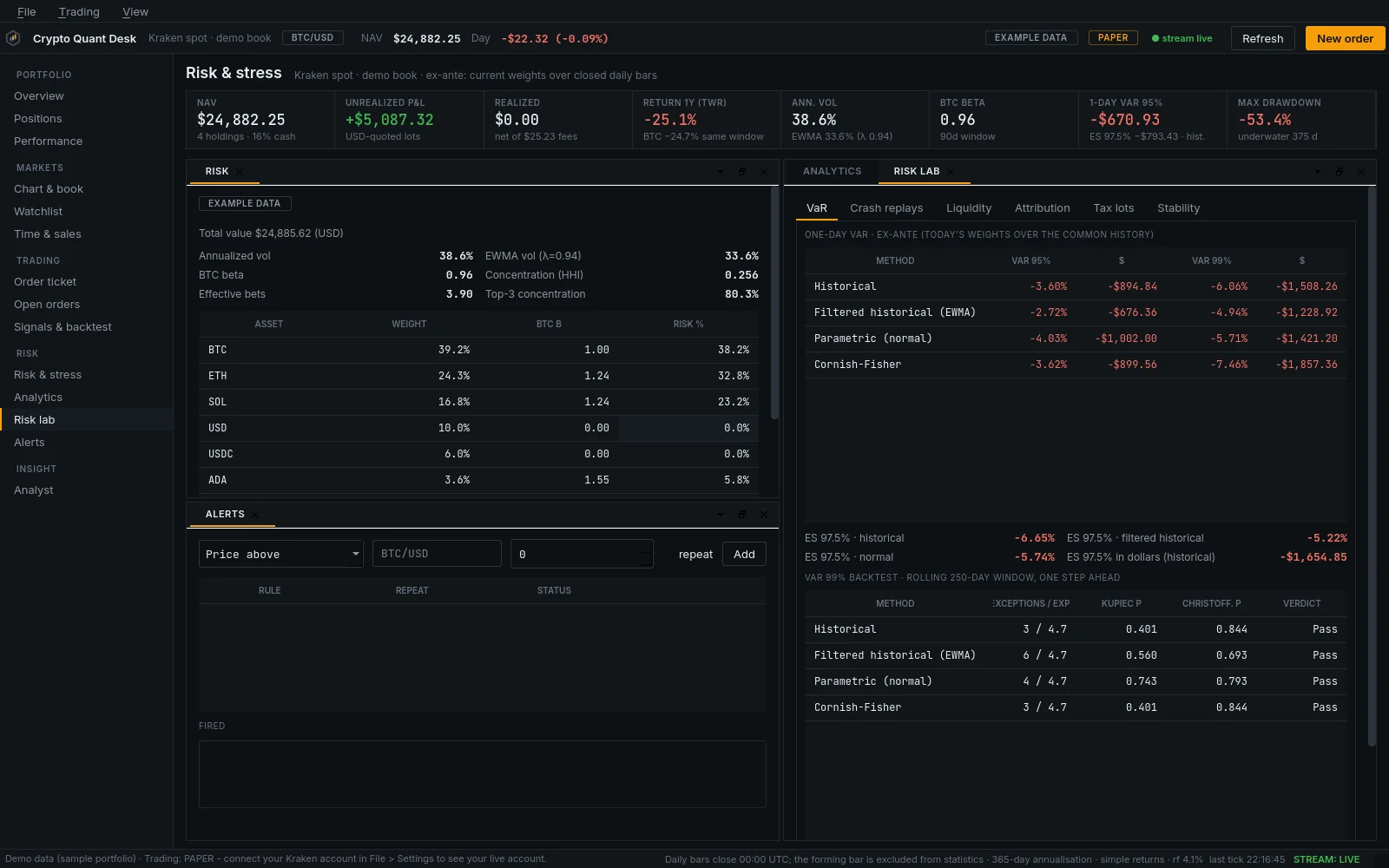
Risk lab: VaR and backtests
One-day VaR four ways and ES 97.5%, each backtested over a rolling 250-day window with Kupiec and Christoffersen tests.
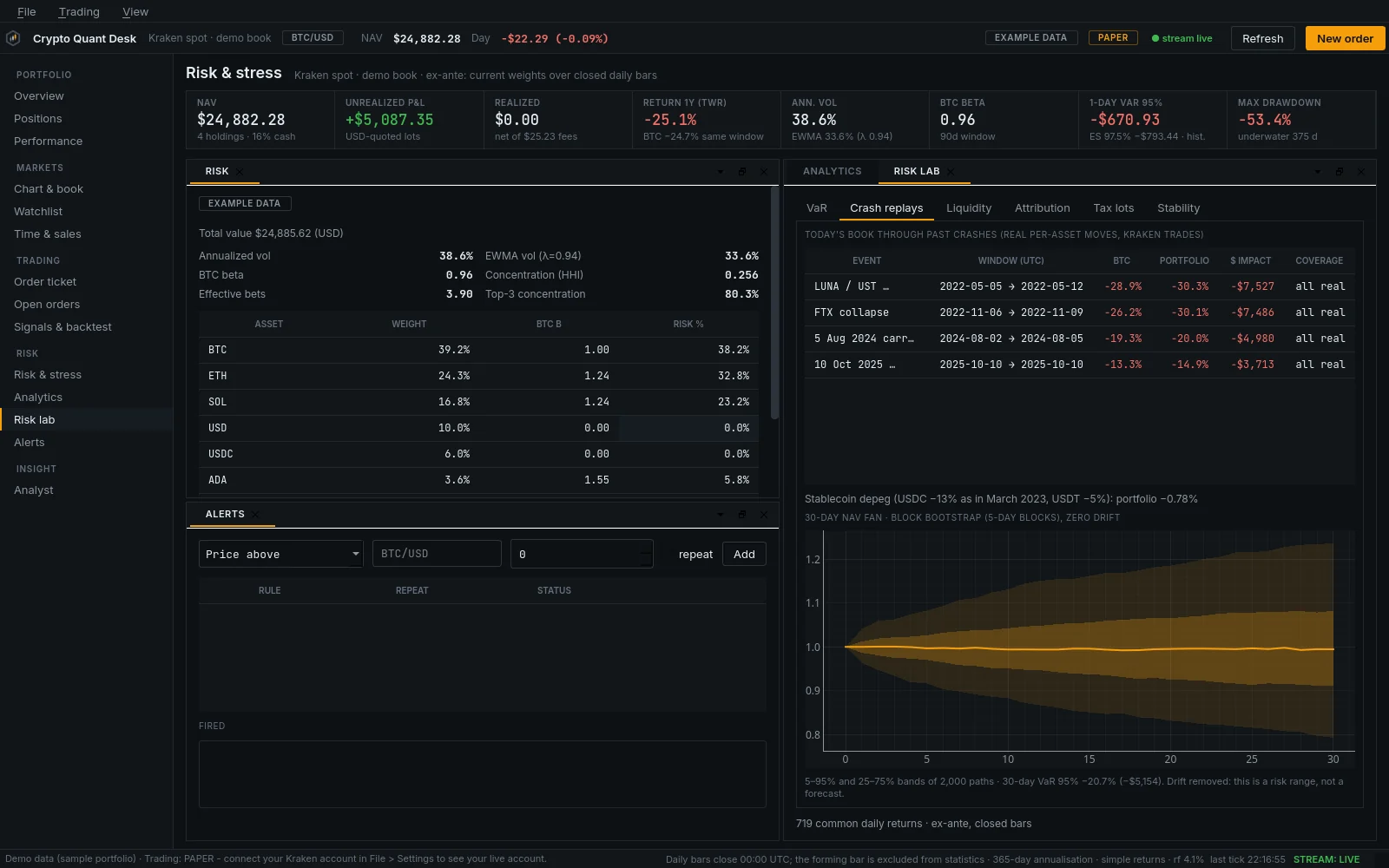
Risk lab: crash replays
Today's book run through LUNA, FTX, the Aug 2024 carry unwind and the 10 Oct 2025 cascade using real Kraken trades, plus a 30-day bootstrap NAV fan.
Methodology
- Closed bars only. Kraken's OHLC always ends with the candle still forming. Every statistic and signal drops it, so intraday moves never leak into vol, VaR or signals. Only the chart draws the live bar.
- Time-weighted returns. Deposits and withdrawals are valued at the same daily marks as the account and removed with a Modified Dietz weight. Returns are then chain-linked, so a deposit is never counted as a gain.
- Two risk views, labelled. The Risk card is ex-ante: today's weights over closed daily bars. Analytics is realized history. Each card's footnote names its window, which is why their vols can differ.
- VaR set. Historical, filtered historical (EWMA, λ 0.94), parametric normal and Cornish-Fisher VaR, plus historical, filtered and normal ES 97.5%. Each is backtested over a rolling 250-day window, one day ahead at 99%, showing its exception count against the expected count, a Kupiec proportion-of-failures p-value, a Christoffersen independence p-value and a pass/fail verdict.
- Crash replays. Four windows rebuilt from Kraken's public trade history: LUNA (May 2022), FTX (Nov 2022), the 5 Aug 2024 carry unwind and the 10 Oct 2025 liquidation cascade. The OHLC endpoint keeps only 720 bars, so it could not supply them. An asset with no history in a window is proxied and labelled. A stablecoin depeg shock and a 30-day block-bootstrap NAV fan complete the tab.
- Attribution. Active return against BTC splits exactly into allocation (cash versus invested), BTC beta and selection, and the three parts sum to the active return.
- Backtest. Signals are taken on closed bars and fill at the next open plus slippage. A stop or target that gaps through fills at the open. Fees and slippage match the paper broker (40 bps taker, 5 bps). Parameters come from an anchored walk-forward that is chosen in-sample and traded out-of-sample, and results are reported in R. The stability heatmap shows whether the chosen parameters sit on a plateau or on a lone bright cell.
- Tax lots. FIFO, HIFO and average cost appear side by side. Realized plus unrealized is the same under every method, and a test enforces it. The figures are arithmetic, not tax advice.
Risk controls
- Paper first. Paper mode is the default. Going live requires typing LIVE.
- Confirm every order. Every order passes through a confirmation dialog with an estimated cost and fee, and needs two clicks at minimum.
- Order cap. A max-order-value cap (default $500) applies in both paper and live mode. It fails closed when there is no price. It is re-checked at send time, together with the trading mode, so a change after the confirm dialog refuses the order rather than resizing it.
- No withdrawals. Orders are submitted with a single-use token from the confirm step. Private endpoints are allowlisted, and none of them can withdraw.
- Audit log. Every order attempt and its outcome go to a local JSONL audit log, kept outside the repo, with no key material.
- Signals never trade. Signals only pre-fill the ticket. Nothing turns a signal into an order, and a test enforces that.
- Keys in the OS vault. Keys live in the OS credential vault (Windows Credential Manager or macOS Keychain), never on disk in plaintext. These rails have their own tests.
Architecture
- Pure engine. The engine takes plain data and returns dataclasses, imports nothing from the UI or network, and is tested with hand-computed vectors.
- Responsive UI. Network work runs on an asyncio loop shared with Qt (qasync). Heavy analytics run off the UI thread. Panels load when first shown.
- Demo mode. A sample book with live Kraken public data, so the whole app works without keys.
- Packaging. PyInstaller with an Inno Setup installer that contains no credentials or personal data. Dependencies are locked in uv.lock.
cqd/
  data/     Kraken REST + WebSocket clients, demo client, normalisation,
            ledger-derived portfolio, returns, crash history, track record
  engine/   pure functions: risk, metrics, var, stress, attribution, tax_lots,
            cost_basis, performance, backtest, signals, microstructure, scenario
  trading/  order service (prepare -> confirm -> send), paper broker,
            limits, audit log
  analyst/  rules-based narration + optional LLM over engine outputs
  alerts/   rule engine + desktop notifications
  ui/       PySide6 shell: nav rail, KPI strip, six pages of QtAds dock panels,
            Graphite theme tokens
What I fixed and why
An audit of the app's own math found numbers that looked right but were wrong. I fixed them one commit at a time, each with a test that fails on the old behaviour:
- Deposits counted as performance. Returns came from equity.pct_change(), so a deposit read as a gain. A flat cash account with one deposit showed a 7,183% annual return and a Sharpe of 2.49. Returns are now time-weighted with flows removed.
- The forming candle fed the statistics. Kraken's last OHLC row is still live, so intraday moves leaked into vol, beta and VaR, and signals repainted. Statistics and signals now use closed bars only.
- Fees missing from cost basis. A 0.40% taker buy at 50,000 showed a break-even of 50,000 instead of 50,200. Two "realized P&L" figures also disagreed about sell fees. Both paths now treat fees the same way.
- Drawdown missed day-one losses. The wealth index started after the first return, so a −20% first day showed 0% max drawdown. Risk and Analytics also computed different Sortino values for the same series. There is now one wealth index and one set of ratio functions.
- Sharpe assumed a zero risk-free rate. It now uses a configurable rate, defaulting to the 3-month T-bill.
- An optimistic backtest. It filled at the signal bar's close, ignored costs and gaps, and had no true out-of-sample test. A breakout fill bias was worth +0.26R a trade on a driftless random walk. It now uses next-open fills, costs, gap-aware stops and an anchored walk-forward.
- Live signal P&L was gross, and open signals were lost on restart. P&L is now net of fees and slippage, and pending signals persist.
- Sizing could exceed the cash on hand. Setups are now capped at the free balance, and a zero balance means no trade.
- The order cap was checked only at confirm. It is now re-checked, along with the mode, just before sending.
- The VaR figure had never been tested. It now comes as a set of models, each backtested.